
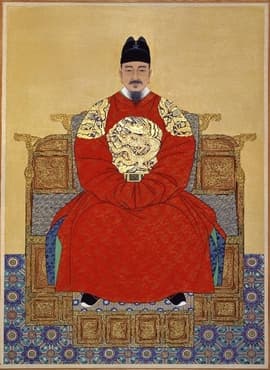
Most alphabets, like the one you are reading right now, weren't designed by anyone. They drifted from one script into another over hundreds of years. Hangul is different. It was created on purpose by King Sejong the Great in 1443, with the help of his scholars. The king wanted writing that any farmer or child could learn in a few days.
There are only 24 letters in Hangul - 14 consonants and 10 vowels. The clever bit is the shape of each one. The consonant shapes copy what your mouth, tongue and throat are doing when you make that sound. For example, the letter ㄴ (n) looks a bit like the side view of a tongue touching the roof of the mouth. Once you know the trick, the letters almost teach themselves.
Letters in Hangul are not written in a straight line, the way English ones are. Instead, two or three letters get stacked into a little square block to make one syllable. The word 'Korea' in Korean is 한국 - just two blocks. Each block is one beat: han · guk.
Today, Hangul has its own national holiday in South Korea on 9 October - 'Hangul Day' - to celebrate the alphabet. Schools have writing competitions, and people sometimes wear t-shirts with Hangul letters as a design. Linguists (scientists who study language) often call Hangul one of the most logical writing systems ever invented.