
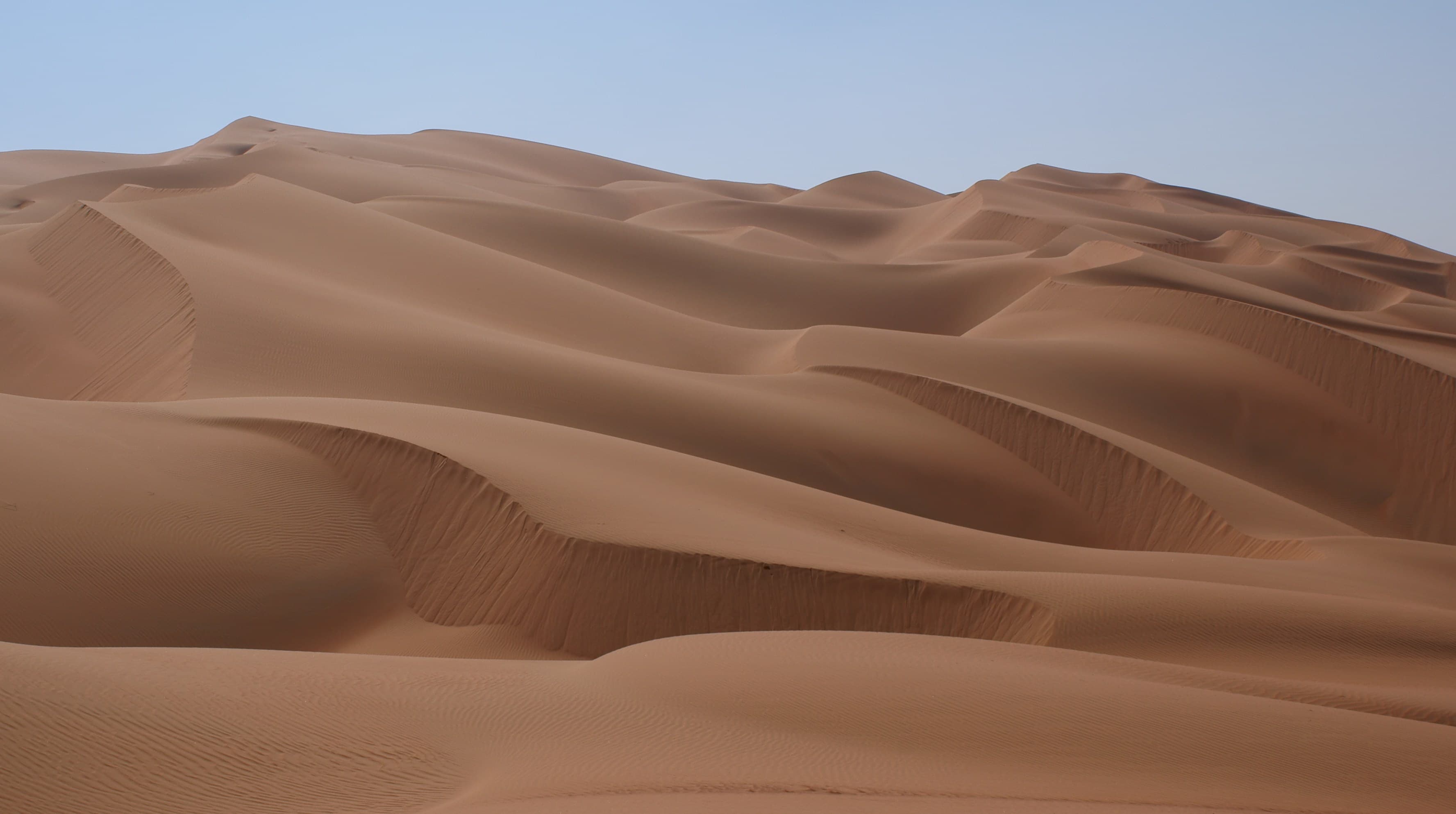
Most of the Empty Quarter looks like a frozen orange ocean - hill after hill of soft sand. The dunes move slowly, pushed by the wind a few metres each year. Some dunes are shaped like long ridges. Others curve into giant crescents. Geographers love studying their patterns from satellite photos.
For most of human history, only Bedouin families - the desert nomads of Arabia - crossed it. They travelled on camels, carrying water in goatskin bags, and knew exactly which routes had wells. Even today, very few people live deep in the desert. The world's first non-Bedouin to cross it on foot did so less than 100 years ago, in 1931.
Surprisingly, the Empty Quarter wasn't always empty. Long ago, the climate was wetter, and scientists have found ancient lake beds and animal bones buried in the sand. Hippos, giraffes and elephants once lived where there is now nothing but dunes.
At night, with no lights for hundreds of kilometres, the sky over the Empty Quarter is one of the darkest on Earth. The Milky Way is so bright you can see it cast a faint shadow on the sand. Astronomers and travellers come just to look up.