
Classroom lesson · Białowieża - Europe's last primeval forest · 🇵🇱 Poland

Białowieża - Europe's last primeval forest

An ancient woodland with 800-year-old trees and herds of wild bison

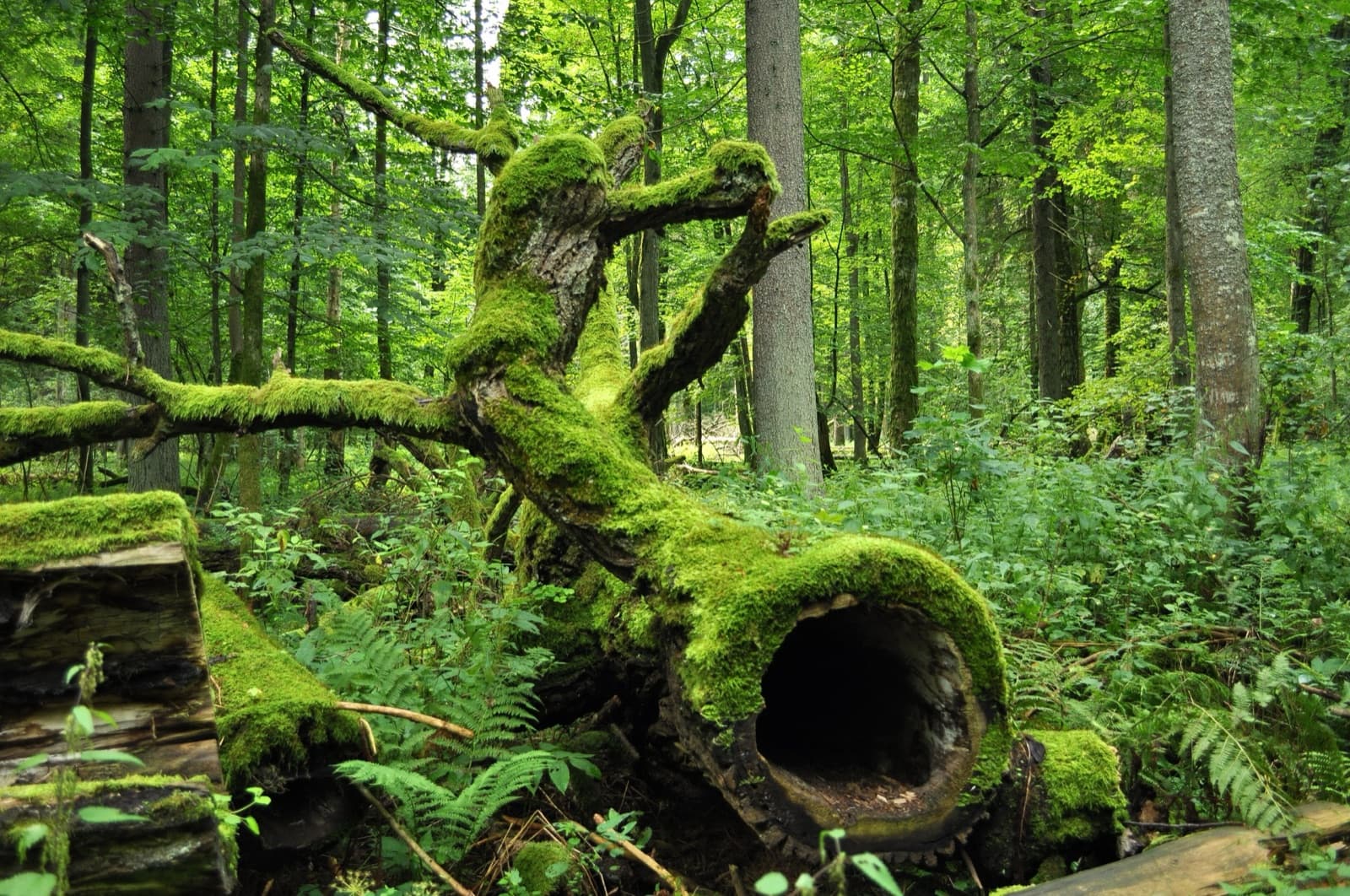
Tall ancient oaks and mossy ground in the Białowieża Forest

Photo · Wikimedia Commons

What is it?

Białowieża (pronounced 'bia-wo-VYEH-zha') is the last big stretch of wild forest left in Europe that has never been chopped down. Some of its oak trees have been growing for over 800 years - older than most castles. It is also home to the European bison, the biggest land animal in Europe.

Tell me more

Most forests in Europe today are 'managed' - the trees are planted in tidy rows and cut down every few decades. Białowieża is different. The trees fall when they're ready, the moss creeps over the logs, and new trees grow up in the gaps. It is what most of Europe looked like thousands of years ago.

Walking through Białowieża feels like stepping into a fairy tale. Some oaks are so wide that it takes five children holding hands to circle the trunk. The forest floor is soft and springy with hundreds of years of fallen leaves. Woodpeckers drum on the dead wood, and in winter the snow muffles every sound.

The most famous animal here is the European bison, called żubr (pronounced 'zhoobr') in Polish. They are huge - a male can weigh almost a tonne, about the same as a small car. A hundred years ago they had almost disappeared from the wild. Polish foresters and scientists slowly brought them back, and today around 800 bison live free in Białowieża.

Other animals share the forest too: wolves, lynx, beavers, moose and deer. Because nobody has cut the forest down, lots of rare insects, mushrooms and plants live here that you cannot find anywhere else on the continent.

In the classroom

Walk your class through this in 15 minutes.

Talk together

Discussion prompts

  1. 01What is the difference between a 'wild' forest and a 'planted' one?
  2. 02European bison were almost gone, but people brought them back. What does that tell us about how nature can recover?
  3. 03If you could walk for a day in Białowieża, what would you most want to see?
Try this

Classroom activity

Find the oldest tree near your school. Measure how wide it is around the trunk by holding hands in a ring of children. Then look up roughly how old it might be. How does it compare to an 800-year-old Białowieża oak?