
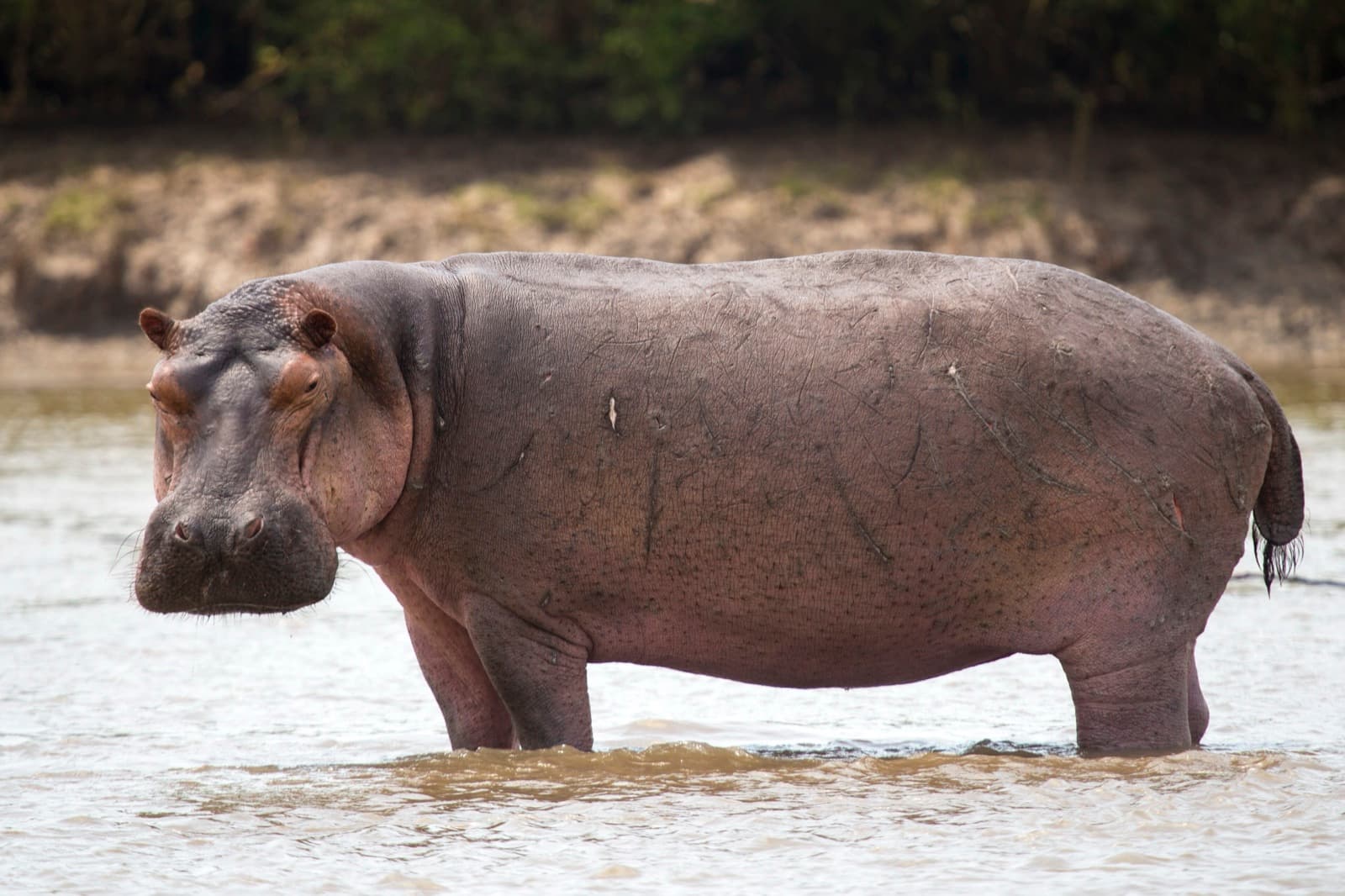
The word 'hippopotamus' comes from ancient Greek and means 'river horse'. They are not actually related to horses - their closest living cousins are whales and dolphins. Hippos have been hanging around rivers, looking surprisingly chunky, for around 55 million years.
Hippos spend most of the day in water to keep cool and protect their skin from the sun. Their skin is so sensitive that it sweats a special pink oil that works like sunscreen. Yes - hippos make their own sunblock, and it really is a bit pink.
They look slow, but they're not. On land, a hippo can run at 30 km/h - faster than most humans can sprint. Underwater, they don't actually swim; they push off the bottom and 'gallop' along the riverbed in a slow-motion bounce. They can hold their breath for 5 minutes.
Ancient Egyptians had a goddess shaped like a hippo, called Taweret. She was the protector of mothers and babies, because Egyptians had seen how fiercely a mother hippo defends her calves. Some of the oldest hippo statues ever found are from Egypt - small blue ones called 'William the Hippo' are still famous museum pieces.