
Classroom lesson 路 Wildlife馃嚜馃嚞 Egypt

The dromedary camel

The desert's all-terrain vehicle, with one hump and incredible legs

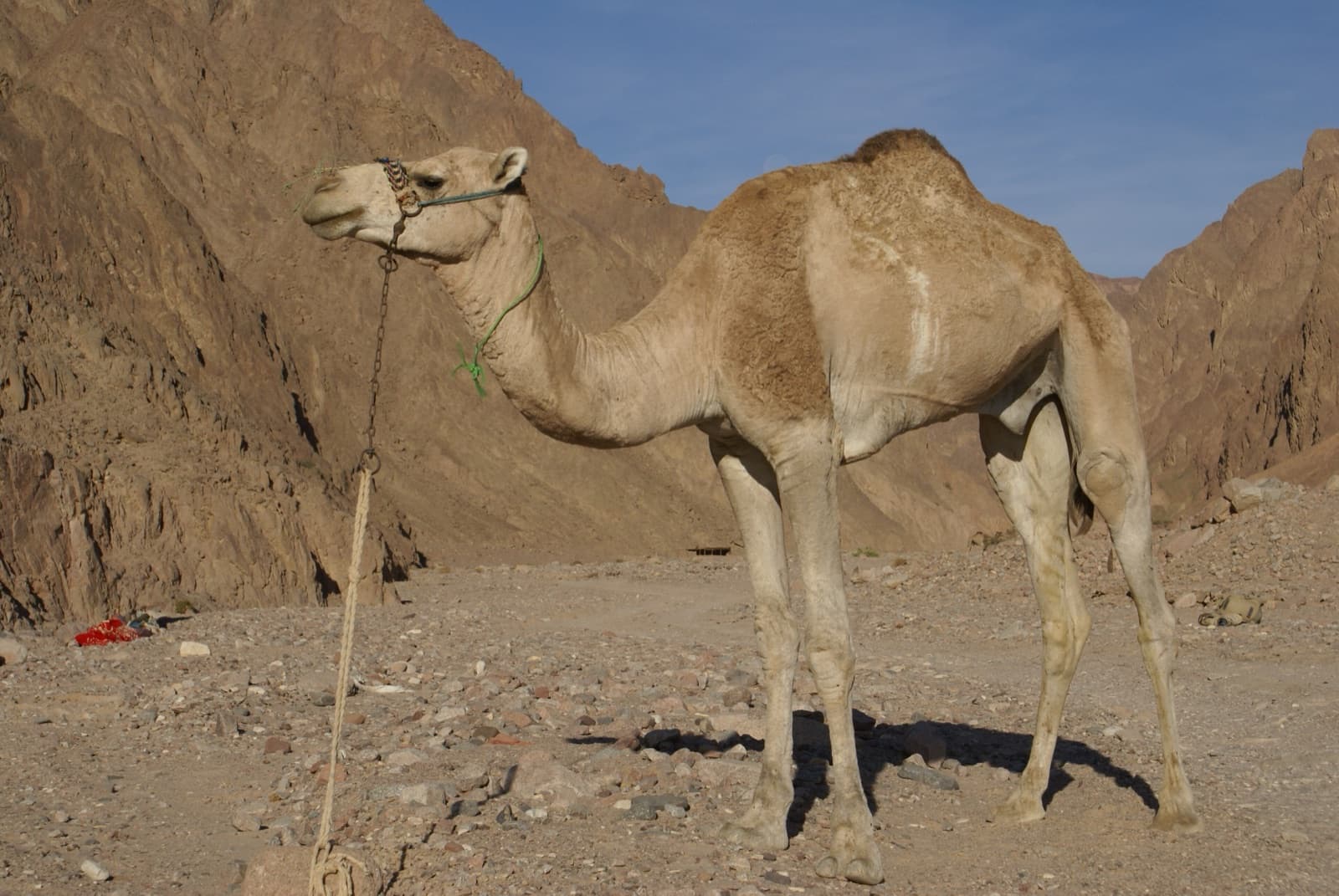
A dromedary camel standing in the Egyptian desert

Photo 路 Wikimedia Commons

What is it?

The camel you see in Egypt is the dromedary - the kind with one hump. (Its cousin the Bactrian camel, found further east, has two.) Camels are built for the desert in almost every possible way, from their feet up to their eyelashes.

Tell me more

A camel's hump is not filled with water, as some people think. It is filled with fat - up to 36 kilograms of it. When food is hard to find, the camel's body uses up the fat in the hump, slowly, like a built-in lunchbox. A camel that hasn't eaten for a long time has a floppy, leaning hump.

Camels are amazing with water. They can drink up to 100 litres in one go - that's about 200 large drink bottles - and then go more than a week without drinking again. Their bodies are so good at saving water that they barely sweat, even in the desert sun.

Their feet are wide and soft, like cushions. They spread out as the camel steps down, so it doesn't sink into the sand. They have two layers of long eyelashes, ears full of hair, and nostrils they can close - all to keep sand out during desert storms.

Camels can carry heavy loads for days without complaining. In Egypt and across the Sahara, people have travelled with camels for over 3,000 years. Long camel journeys are still called 'caravans' - and that is exactly where the English word came from.

In the classroom

Walk your class through this in 15 minutes.

Talk together

Discussion prompts

  1. 01If a camel's hump is full of fat, what does the hump tell you about the camel? Why might it be floppy sometimes?
  2. 02Almost every part of a camel's body is designed for the desert. What features would you design into an animal that lived where you live?
  3. 03Why do you think people travelled in big groups (caravans) instead of one at a time across the desert?
Try this

Classroom activity

List five places on Earth where an animal would need to look very different from a camel. For each, design a creature: what kind of feet? Eyes? Hair? Food? Discuss as a class - what does each design tell us about the place?