
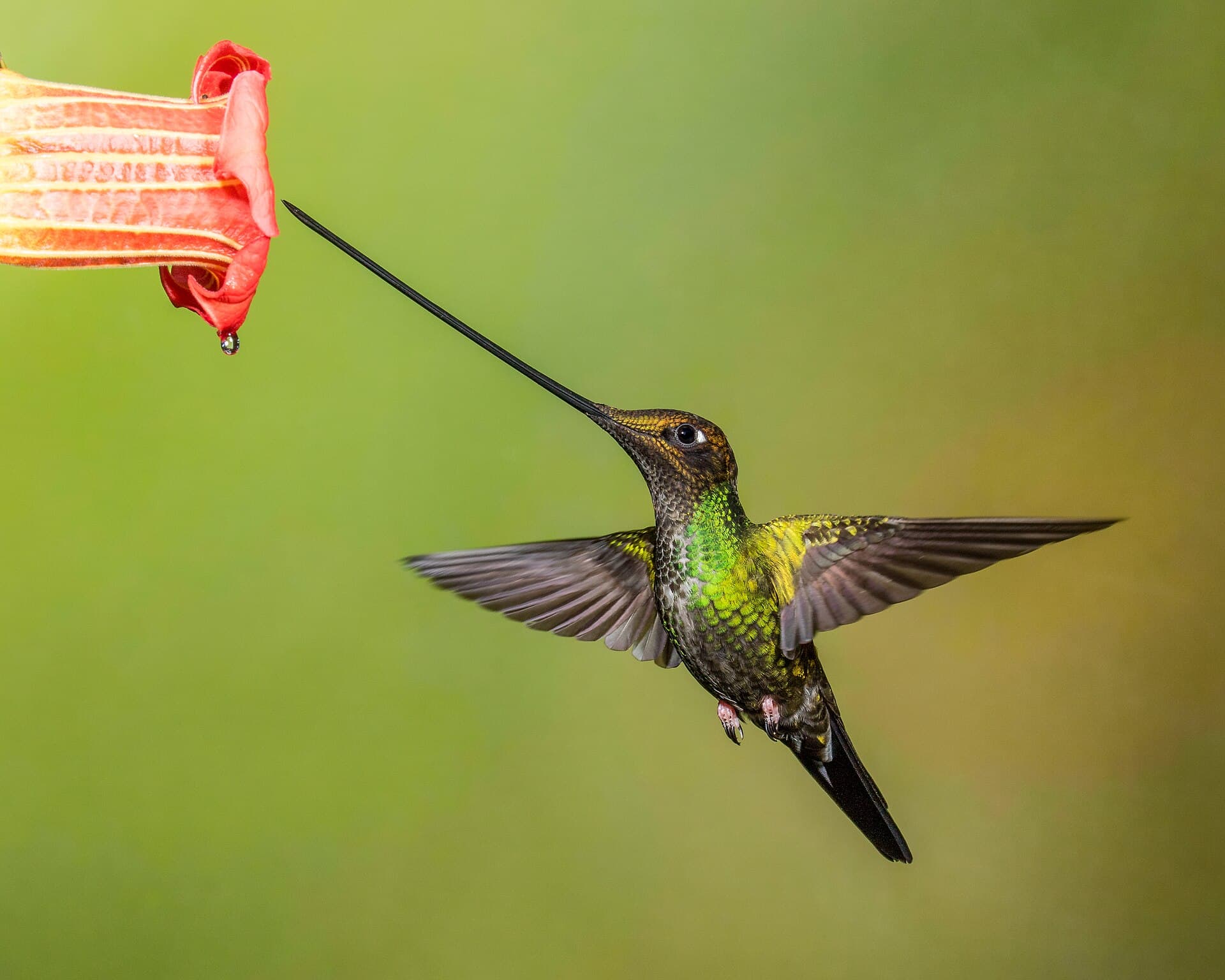
A hummingbird's wings beat between 50 and 80 times every second. That is so fast that humans cannot see the individual beats - we just see a buzzing blur. The sound the wings make is the humming that gives the bird its name. To hover in one place, a hummingbird can even fly backwards - something almost no other bird can do.
Hummingbirds need to eat a huge amount of food to power all that wing-beating. A hummingbird visits hundreds of flowers every day and drinks more than its own body weight in nectar. As it feeds, it picks up pollen from one flower and carries it to the next, helping plants reproduce. Without hummingbirds, many Colombian mountain flowers could not make seeds.
Colombia's many different altitudes and habitats mean an extraordinary variety of hummingbirds have evolved here. Near the coast there are tiny ones the size of a big bumblebee. High in the Andes there are spectacular ones with tail feathers longer than their bodies. Each has a bill shaped perfectly for the flowers in its own habitat.
The largest hummingbird in the world is the Giant Hummingbird, which lives in the Andes. Even 'giant', it is only about 21 cm long - the size of a large sparrow. The smallest, the Bee Hummingbird, lives in Cuba and is about the size of a thumb.