
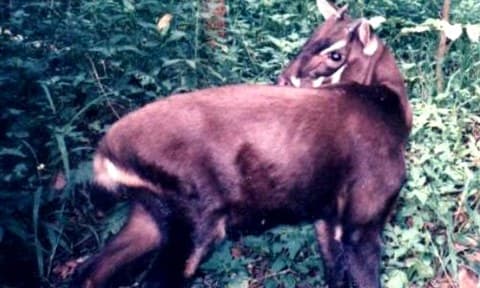
The saola was unknown to science until 1992. That year, a team of researchers exploring a forest in Vietnam spotted a pair of unusual long horns on the wall of a hunter's house. They had never seen anything like them. They realised an entire kind of animal had been living in those forests, almost completely unknown to the outside world.
Saolas are about the size of a goat, with chocolate-brown fur and bright white patches on the face - like a clever painter has dotted them on. Both males and females have long, almost-straight horns that curve gently backwards. From the front, the two horns look like one, which gave the animal its 'unicorn' nickname.
Nobody knows exactly how many saolas are left, but scientists think it is very few - probably only a few dozen or so in the wild. They live deep in cloudy mountain forests where they are very hard to find. The few times a saola has been caught on a hidden camera, it has been front-page news for wildlife scientists.
Today, teams of guards in Vietnam and Laos walk through the saola's forest home looking for traps left behind by poachers. They remove the traps so the animals can move safely. Schools nearby tell their pupils about the saola so a whole new generation grows up wanting to look after it. If we are careful and gentle, the saola might still be roaming Vietnamese forests for many years to come.