
Classroom lesson · CERN - the giant science machine underground · 🇨🇭 Switzerland

CERN - the giant science machine underground

A 27-km circle buried under Switzerland, where scientists study the smallest things in the universe

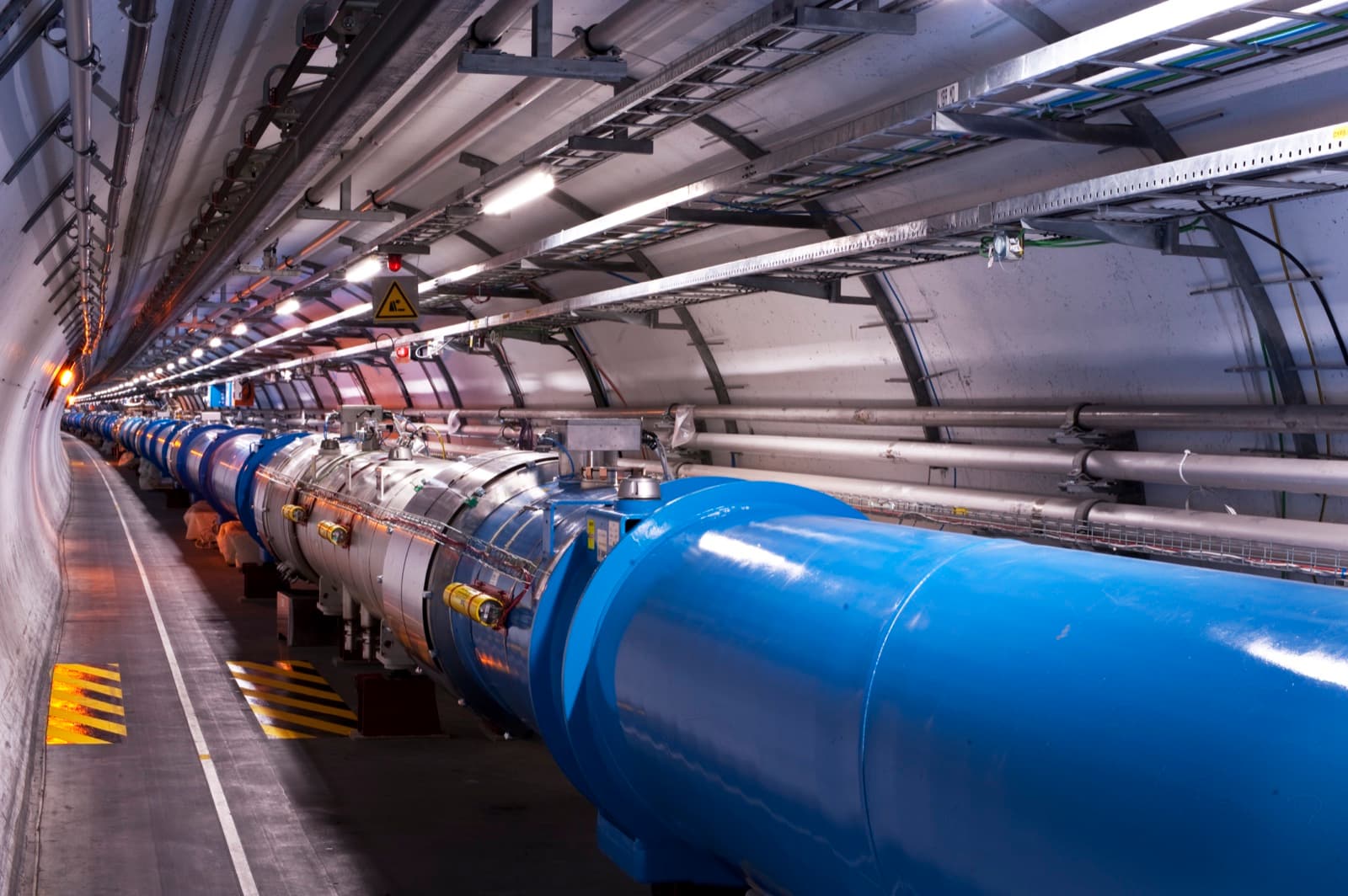
The Large Hadron Collider tunnel at CERN

Photo · Wikimedia Commons

What is it?

Just outside Geneva, on the border between Switzerland and France, scientists from all over the world have built one of the biggest machines on Earth. It is called the Large Hadron Collider, or 'LHC' for short, and it is part of a science centre called CERN. The machine is a giant circular tunnel buried 100 metres underground.

Tell me more

The LHC tunnel is 27 kilometres around - longer than most cities. Inside the tunnel, scientists send tiny particles (smaller than atoms) whizzing around the loop. The particles travel almost as fast as light itself - over 1 billion kilometres an hour - and crash into each other on purpose, so the scientists can study what they are made of.

Why do this? Because the smallest things in the universe make up everything bigger - including you, this room and the stars in the sky. By studying tiny particles, scientists can understand how the whole universe works. In 2012, CERN scientists found a tiny particle called the Higgs boson, which helps explain why anything has weight at all.

CERN is also where the World Wide Web was invented. In 1989, a British scientist named Tim Berners-Lee was working there and wanted an easier way to share documents with colleagues. He invented the web so any computer in the world could open the same page. Every website you have ever used began with that idea.

About 17,000 people from over 100 countries work together at CERN. Scientists who would never meet otherwise share offices, swap ideas in the lunch queue and write papers together. It is one of the biggest examples in the world of countries cooperating to do something only humans together could do.

In the classroom

Walk your class through this in 15 minutes.

Talk together

Discussion prompts

  1. 01Why might it help scientists from many countries to work together on one big experiment?
  2. 02Everything around us is made of tiny particles. What is the smallest thing you can imagine? What about smaller than that?
  3. 03The World Wide Web started as a way for scientists to share notes. What is something you wish was easier to share between people?
Try this

Classroom activity

Mark out 27 metres in the playground (one thousandth of the LHC's size). Take it in turns to walk around the loop. Talk about how it would feel to be a particle whizzing round 11,000 times a second.