
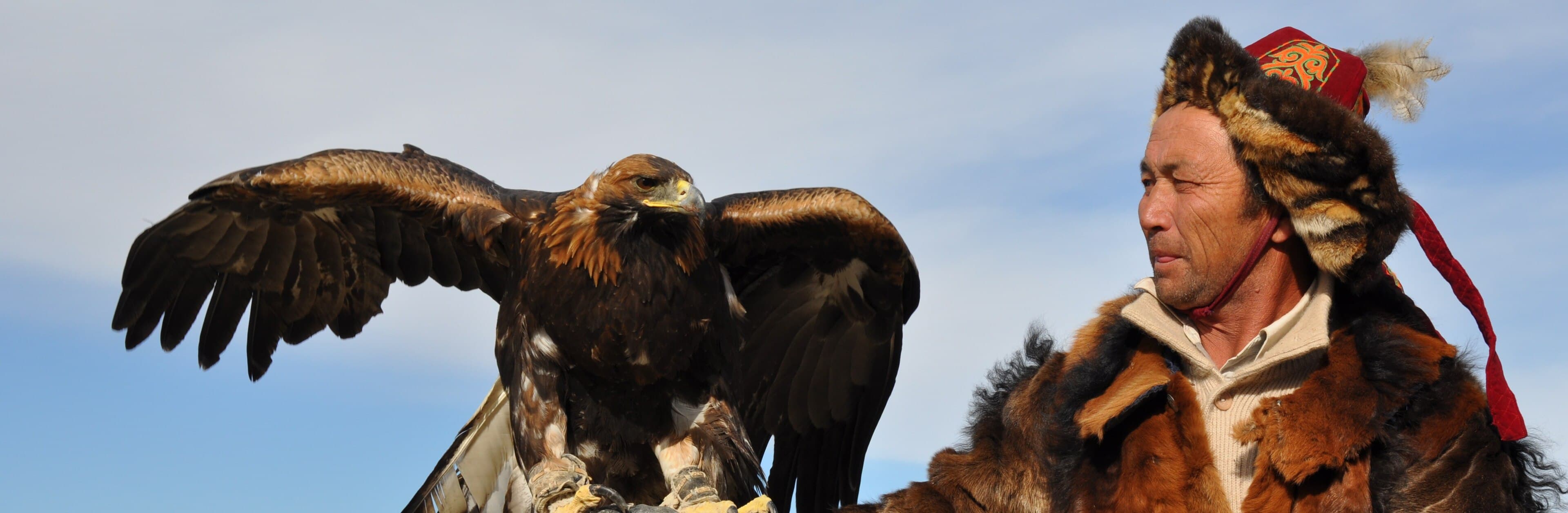
Training a golden eagle is a lifetime's work. A hunter captures a young eagle as a chick or fledgling and spends months teaching it to come to the arm on command, return when called and fly toward prey on the mountainside. The eagle is never caged - it perches on a special padded glove on the hunter's arm and is treated as a close companion. After seven to ten years, many hunters release their eagle back to the wild so it can live freely and raise its own young.
Golden eagles are huge birds - their wingspan can stretch to over two metres. They are extraordinarily powerful and can spot a fox or a rabbit from kilometres away. In the Altai winter, hunters ride on horseback across snowy mountain slopes, releasing their eagle to help catch prey. The furs and skins are used for warm winter clothing. The partnership between human and eagle is based on mutual respect, patience and trust built over years.
The Golden Eagle Festival, held in Ölgii in western Mongolia every October, draws eagle hunters from across the Altai and visitors from around the world. Hunters show their skills in competitions - calling their eagle to fly from a high mountain ridge to their arm, accuracy tests, and displays of horsemanship. The hunters wear stunning traditional Kazakh costumes embroidered in deep red, blue and gold. It is one of the most visually magnificent festivals in the world.