
Classroom lesson · Yap stone money - the world's biggest coins · 🇫🇲 Micronesia

Yap stone money - the world's biggest coins

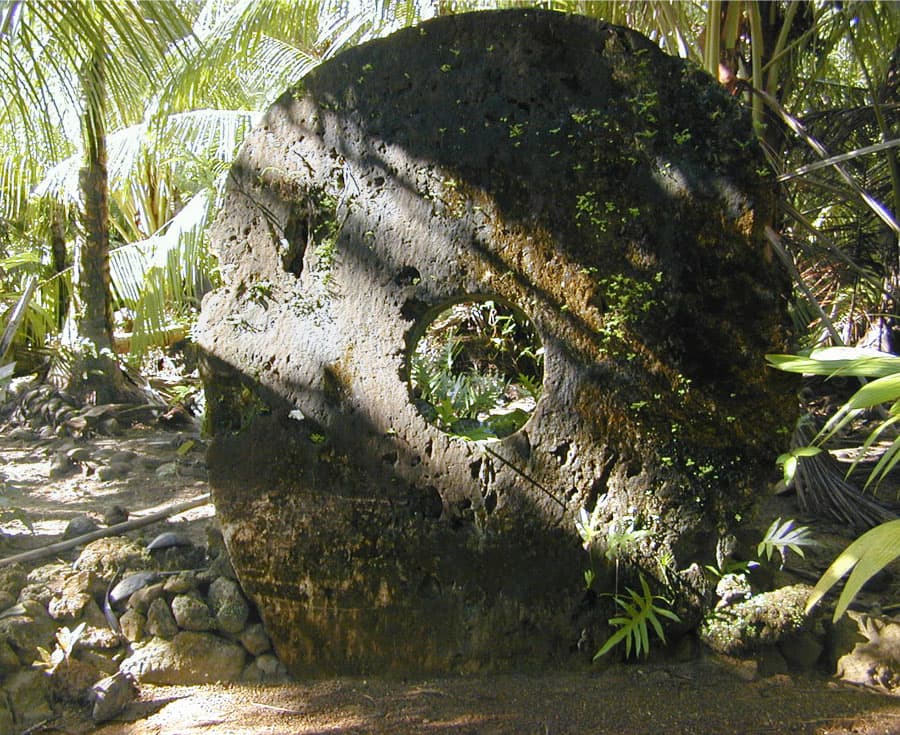
Giant stone discs, some taller than a person, used as currency on Yap island

A row of large circular stone discs standing upright against a wall on Yap island

Photo · Wikimedia Commons

What is it?

On the island of Yap in Micronesia, people used giant stone discs as their traditional money. These discs are called 'rai' and they can be as tall as a person - or even taller. They are made from a special white stone that does not exist on Yap, so people sailed to other islands to carve them and bring them home.

Tell me more

Rai stones are round with a hole in the middle. The smallest are about the size of a dinner plate, but the biggest are over 3 metres across. That is taller than most ceilings in your school. Each stone is so heavy that many of them have never moved at all - they just sit in the same place in the village for hundreds of years.

Here is the amazing part: even when a stone does not move, its ownership can change. If someone does a big favour for another family, gives them food in a hard time, or trades something important, everyone in the village agrees that the stone now belongs to the other family. The stone stays where it is, but its owner is different. The whole village is the bank.

One rai stone famously fell off a canoe into the ocean. It was never recovered - it sank to the bottom of the sea. But people on Yap still counted it as real money! Because everyone agreed it existed and knew who owned it, it kept its value even underwater.

The most valuable stones are not necessarily the biggest - they are the ones with the best story. A stone brought back from a very dangerous voyage is worth more than an easy one. The adventure and effort are part of what makes it valuable.

In the classroom

Walk your class through this in 15 minutes.

Talk together

Discussion prompts

  1. 01Money usually has to be carried around. Yap stone money cannot be moved. What makes something 'money' if it stays in one place?
  2. 02The stone at the bottom of the ocean is still counted as money because everyone agrees it exists. What does this tell us about how trust works?
  3. 03If you could invent your own class currency, what would you use and why?
Try this

Classroom activity

As a class, invent a currency for your classroom. It can be anything - buttons, pebbles, drawings. Decide: how does someone earn one? Can it change hands? What makes one worth more than another? Run the system for a week and discuss what you noticed.