
Classroom lesson · Wildlife · 🇫🇲 Micronesia

Hawksbill turtle - the reef's shell artist

A beautiful sea turtle whose pointed beak lets it reach food inside coral crevices

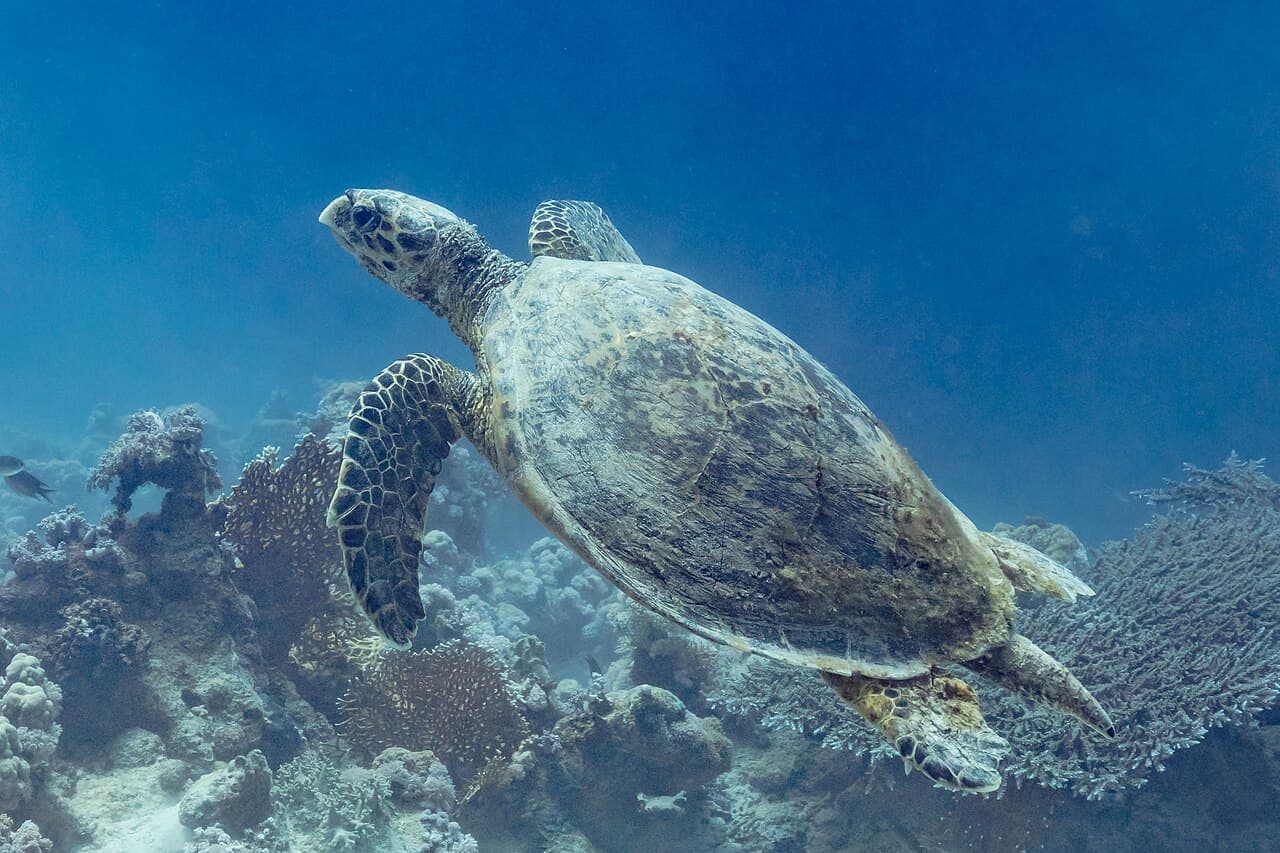
A hawksbill turtle swimming over a colourful coral reef

Photo · Wikimedia Commons

What is it?

Hawksbill turtles are medium-sized sea turtles with a narrow, pointed beak that looks exactly like a hawk's bill. They live on tropical reefs across the Pacific Ocean, and Micronesia is one of their most important homes. Their beautiful shells have orange, brown and yellow patterns that shimmer in the sunlight.

Tell me more

The pointed beak of the hawksbill is a perfect tool for the reef. It reaches into small crevices and gaps in the coral where other animals cannot fit, pulling out sponges to eat. Sea sponges are an important food that most animals ignore, so the hawksbill has an almost exclusive menu. This means it is not competing for the same food as other reef creatures.

By eating sponges, hawksbill turtles actually help the reef. Sponges grow quickly and can smother coral if left unchecked. When the turtles eat them back, they give the coral room to breathe and grow. This makes the hawksbill an important partner for the reef - scientists call animals that play this role 'keystone species'.

Female hawksbill turtles return to the same beach where they were born to lay their own eggs. Nobody is quite sure how they remember which beach, but scientists think they use the Earth's magnetic field as a kind of GPS. They can navigate across thousands of kilometres of open ocean and arrive at almost exactly the right spot.

Baby hawksbill turtles hatch from eggs buried in warm sand, then race to the sea as fast as their tiny flippers can carry them. Once in the water, young turtles drift with ocean currents for years before eventually settling on a reef. Nobody knows exactly where they go during this 'lost years' period - they simply vanish and reappear later as young adults.

In the classroom

Walk your class through this in 15 minutes.

Talk together

Discussion prompts

  1. 01The hawksbill eats sponges that most animals ignore. Why might eating food others do not want be a clever survival strategy?
  2. 02Female turtles return to the exact beach where they were born. How might a magnetic field work like a map?
  3. 03Baby turtles disappear for years. How do scientists try to study animals whose movements are unknown?
Try this

Classroom activity

Create a 'reef food web' diagram on A3 paper. Start with the sun at the top. Draw arrows to algae, then to sponges, then to the hawksbill turtle, and show how the turtle's eating keeps the coral healthy. Add three more animals (parrotfish, manta ray, sea urchin) and draw their connections too.