
Classroom lesson · Wildlife · 🇫🇲 Micronesia

Coconut crab - the world's largest land crab

A huge, tree-climbing crab that can crack open a coconut with its claws

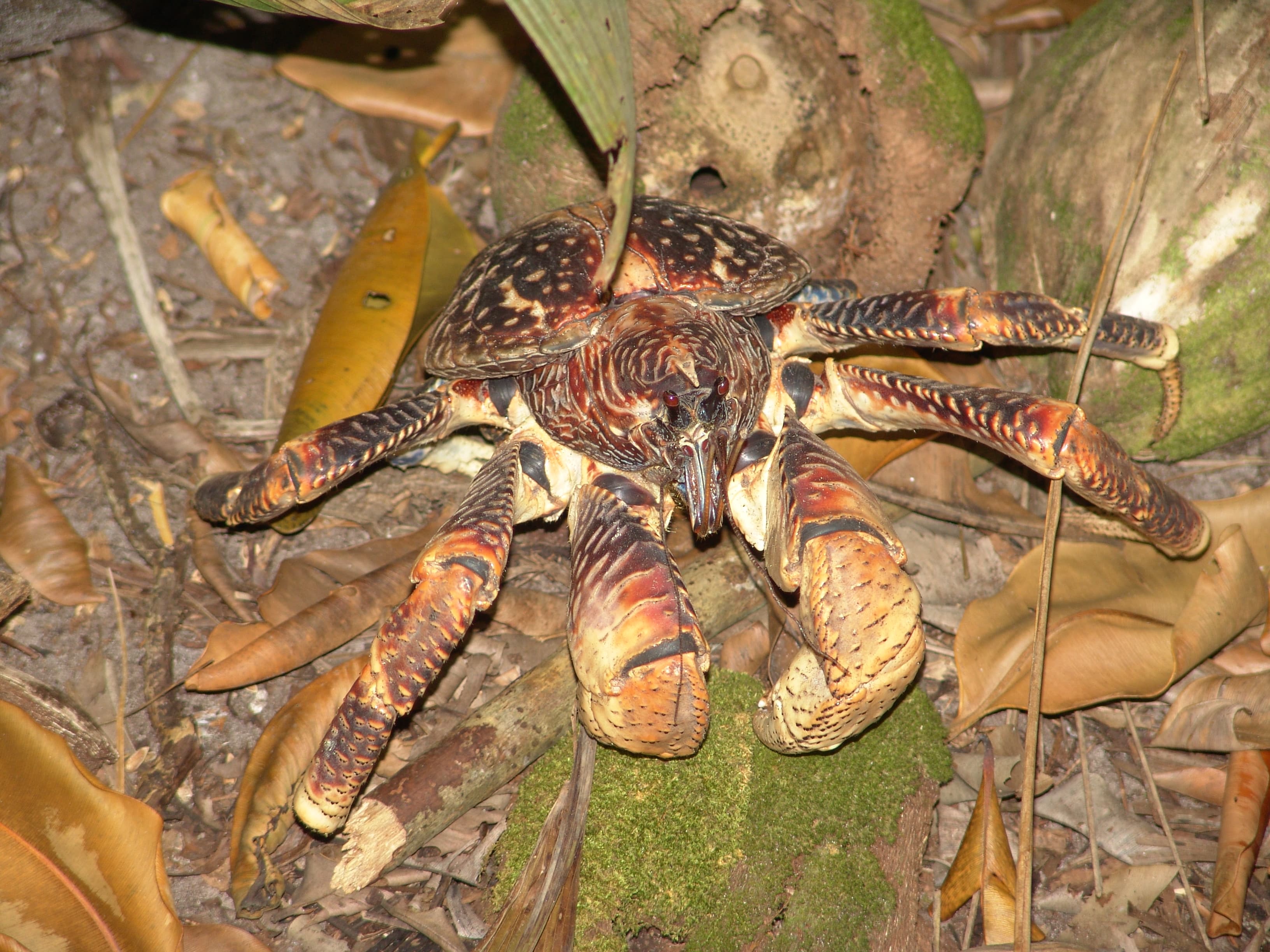
A large coconut crab with blue-red shell clinging to a palm tree trunk at night

Photo · Wikimedia Commons

What is it?

The coconut crab is the biggest land-living arthropod (the group that includes insects, spiders and crabs) in the entire world. It lives on tropical islands across the Pacific, including in Micronesia. Its claws are so powerful that it can crack open a coconut, which is hard enough to challenge a human with a hammer.

Tell me more

A full-grown coconut crab can weigh up to 4 kilograms and measure nearly a metre from one claw tip to the other. Their shells are usually deep blue-purple or orange-red and they look quite extraordinary - like something from a fantasy story. Despite their name, they eat many things: fruit, seeds, nuts, and occasionally other crabs.

Their claws can apply more force than almost any other animal on Earth for their size. Scientists have measured it and found that the grip of a large coconut crab is stronger than the bite force of a lion, gram for gram. They use this strength to pull apart tough husks, pry up rocks and climb trees.

Coconut crabs are brilliant climbers. They can scale smooth palm tree trunks, going up to the fronds at the top where coconuts grow. They sometimes drop coconuts from the tree to crack them open on the ground, then climb back down to eat. They have been spotted 6 metres up in trees.

They are most active at night and spend the day resting in burrows or rock crevices. Despite being crabs, they actually breathe air - they cannot survive underwater. They begin their lives as tiny larvae in the sea, but once they grow up they live on land permanently.

In the classroom

Walk your class through this in 15 minutes.

Talk together

Discussion prompts

  1. 01The coconut crab spends its whole adult life on land, even though it is a crab. What other animals do you know that live very differently from what their name or appearance suggests?
  2. 02Having the strongest grip in the animal kingdom is very useful for cracking coconuts. Can you think of other 'special tools' that animals have evolved for a very specific job?
  3. 03Coconut crabs are active at night. How would your life be different if you slept during the day and explored at night?
Try this

Classroom activity

Test the strength of different 'tools': a nutcracker, a rubber band, a pair of pliers, a hand alone. Which tool can crack a walnut most easily? Design a 'claw' from card and tape that could grip something firmly. Compare your designs as a class.