
Classroom lesson 路 Tsingy - the stone forests馃嚥馃嚞 Madagascar

Tsingy - the stone forests

A landscape of razor-sharp limestone spires, taller than houses

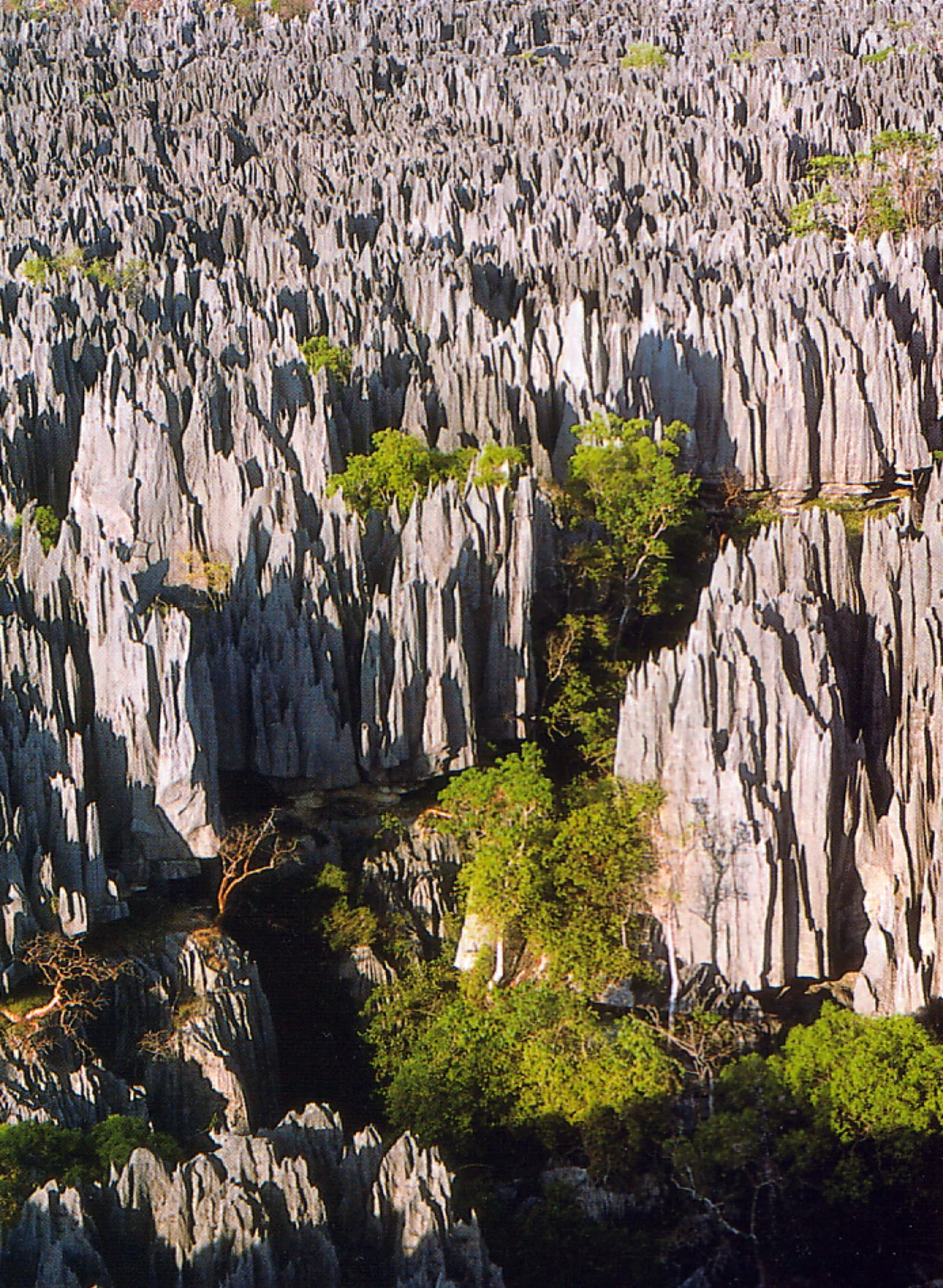
Tall, sharp grey limestone spires rising in a maze-like 'stone forest' in Madagascar

Photo 路 Wikimedia Commons

What is it?

The tsingy are huge fields of razor-sharp limestone rocks that rise out of the ground like a stone forest. The biggest ones tower up to 100 metres tall. In the Malagasy language, the word 'tsingy' means 'where you cannot walk barefoot' - and they are not joking.

Tell me more

The tsingy were made by water. Millions of years ago, this part of Madagascar was under the sea, and the seabed slowly built up into a thick layer of limestone. After the sea level dropped, rainwater dripped through the rock for millions of years, slowly carving the stone into a maze of points and ridges.

From the air, the tsingy look like a giant grey forest made of rock. From the ground, it looks more like a million stone knives all pointing at the sky. Some of the spires are so close together that explorers have to use ropes and ladders to get from one to the next, walking across them on wooden bridges.

Even though the rock is hostile to people, lots of wildlife lives here. Special lemurs called sifakas leap from one stone spike to the next without slipping. Bats sleep in the caves underneath. Plants find tiny cracks of soil and grow upwards, sometimes finding the only puddles of water for kilometres.

The most famous tsingy in Madagascar is at a place called Bemaraha. It is now a UNESCO World Heritage Site, which means the whole world has agreed to look after it. It is one of the most unusual landscapes anywhere on Earth.

In the classroom

Walk your class through this in 15 minutes.

Talk together

Discussion prompts

  1. 01How can soft water carve hard rock? What does that tell us about patience?
  2. 02If you had to design a bridge across a stone forest, how would you build it?
  3. 03What other unusual landscapes can you think of around the world? What made them the shape they are?
Try this

Classroom activity

Take a sugar cube and a small bowl of water. Drip the water slowly onto the cube using a finger or a straw. Watch what happens over a few minutes. Imagine this same process, but with rock instead of sugar, and millions of years instead of minutes.