
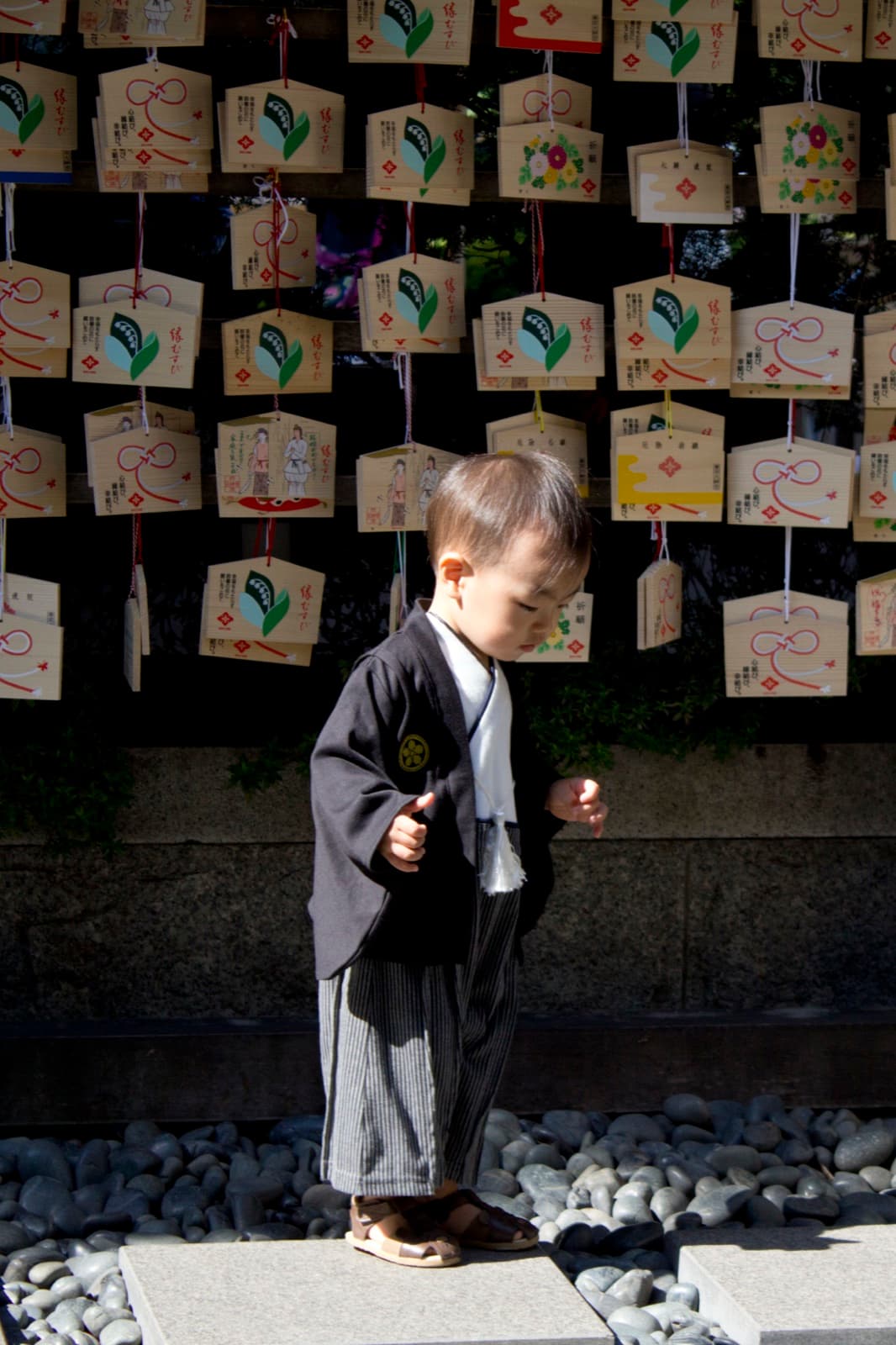
On Shichi-Go-San, families dress the children up in their finest clothes. Many girls wear a kimono - a beautiful long Japanese robe tied with a wide belt. Many boys wear hakama, which are like wide trousers, with a short jacket on top. The whole family gets dressed up too.
Then they visit a local shrine to say thank you for the child's good health so far, and to hope for more. After the visit, the family takes lots of photos. The pictures often hang on grandparents' walls for years afterwards.
Children are given a special sweet on Shichi-Go-San called chitose-ame - 'thousand-year candy'. It is a long, thin stick of red-and-white sticky sweet, wrapped in a paper bag decorated with cranes and turtles (both symbols of long life). The candy is meant to wish the child a long, happy life.
The three ages - 3, 5 and 7 - were chosen long ago because they used to be moments when children's clothes and hairstyles changed. In an older Japan, three-year-olds were allowed to start growing their hair, five-year-old boys were allowed their first hakama, and seven-year-old girls wore their first proper kimono belt. Today, families celebrate the moments more than the rules.