
Classroom lesson 路 Wildlife馃嚝馃嚡 Fiji

Fiji banded iguana

A bright green lizard with white stripes that lives only in Fiji and Tonga

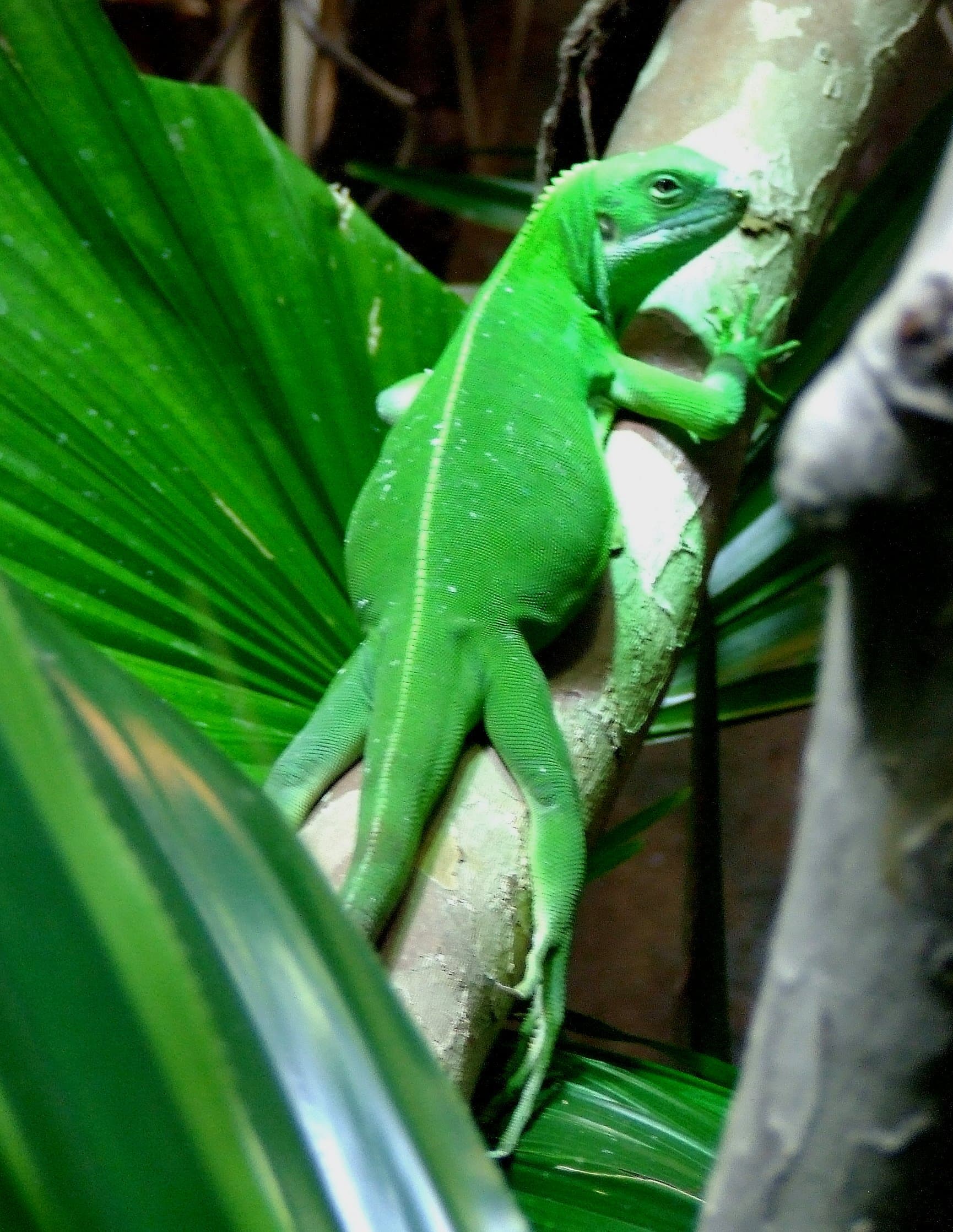
A bright green Fiji banded iguana clinging to a branch with a white stripe along its side

Photo 路 Wikimedia Commons

What is it?

The Fiji banded iguana is a beautiful lizard found only on some islands of Fiji and Tonga - nowhere else in the world. Males are bright leaf-green with two or three pale white bands across their bodies. Females are almost entirely green, which makes them almost invisible among the leaves. They are Fiji's national animal.

Tell me more

Banded iguanas spend almost all their lives in trees. Their toes have tiny gripping pads and curved claws that let them run along branches without slipping. They are so well camouflaged in green leaves that even a sharp-eyed observer standing a metre away can look straight at one and not notice it.

They eat mainly leaves, flowers and fruit - whatever is in season in the forest. In the dry season, when food is scarce, they can slow their bodies down and wait patiently. Being able to go without much food for a while is a very useful skill on a small island.

Male iguanas can change colour when they are excited - flashing brighter green or showing orange patches. This is how they communicate with each other across the treetops: a flash of colour can mean 'this is my tree' or 'hello, I am here'.

The Fijian crested iguana is a close cousin that lives on the island of Yadua Taba. It has three white crests on its back and is one of the rarest reptiles in the world. A community-run sanctuary on Yadua Taba protects the island so the crested iguanas can thrive.

In the classroom

Walk your class through this in 15 minutes.

Talk together

Discussion prompts

  1. 01Female iguanas are a different colour from males. Why might being hard to spot be more useful for a female than a male?
  2. 02Colour change is the iguana's way of sending messages. What other animals communicate with colour? What do they say?
  3. 03The crested iguana lives on just one island. Why might animals on small islands be more at risk than animals on continents?
Try this

Classroom activity

Design a camouflage iguana. Choose a background - jungle leaves, sandy beach, grey rocks. Colour your iguana so it disappears into that background. Then swap with a partner - can they spot your iguana in under five seconds? Discuss: which backgrounds are hardest to hide in?