
Classroom lesson 路 Wildlife馃嚘馃嚥 Armenia

The bezoar ibex - the mountain goat

Wild goats that leap across cliffs in the Armenian highlands

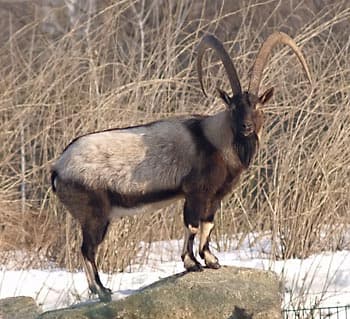
A bezoar ibex with long curved horns on a rocky cliff

Photo 路 Wikimedia Commons

What is it?

The bezoar ibex (BEZ-oh-ar EYE-becks) is a wild goat that lives in the mountains of Armenia. The males have huge curved horns that sweep back over their heads like swords. They are amazing climbers - they can leap across cliff faces that look impossible, balancing on tiny ledges.

Tell me more

Bezoar ibex are about the same size as a large dog, with short fur that turns from sandy brown in summer to a thick winter coat. The males' horns can grow more than a metre long - bigger than the goat's whole back. They use the horns to push each other gently in friendly contests, like wrestlers.

Their feet are the secret to their cliff-climbing. Each hoof has a hard outer edge and a soft rubbery middle - so it grips rough rock the way a climbing shoe does. They can stand on a ledge no wider than your hand.

Bezoar ibex live in groups called herds. Mothers and young goats stay together; the older males sometimes wander alone. They eat grasses, herbs and the leaves of shrubs that grow in the cracks of the cliffs. In winter they come down to lower slopes where the snow is thinner.

These wild goats are the ancestors of all the farmed goats in the world. Thousands of years ago, people in this region started looking after the tamest, friendliest bezoar goats - and slowly, over many generations, those goats turned into the goats that give us milk and cheese today. Wild bezoar goats never stopped being wild.

In the classroom

Walk your class through this in 15 minutes.

Talk together

Discussion prompts

  1. 01Why might it be helpful to have rubbery soles on your feet if you live on cliffs?
  2. 02Wild bezoar goats turned into the farm goats we know today. What other wild animals do you know that have tame cousins?
  3. 03Why might wild goats want to live somewhere as hard to reach as a cliff face?
Try this

Classroom activity

Compare different animals' feet on a class poster: human, dog, goat, eagle, frog. Draw each one and label why it works for that animal. Whose feet would be best for climbing a cliff? Whose for running fast on grass? Whose for swimming?