
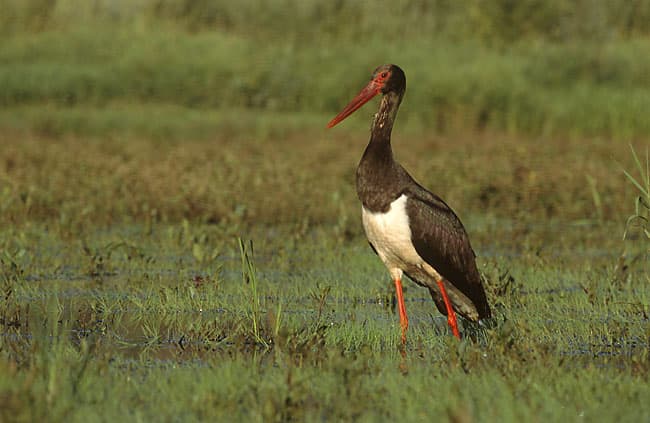
Black storks build huge stick nests high up in old oak or pine trees, often near a quiet river or lake. The same pair returns to the same nest every year, adding new sticks to it. After many years, the nest can be over a metre across - big enough for a child to curl up in.
They feed mostly on fish, frogs and water insects. A black stork wades carefully through shallow water, watching the surface with its sharp eyes. When it spots something, its long beak shoots down faster than you can blink. Most fish never even see it coming.
Every autumn, Ukrainian black storks set off on an enormous journey. They fly all the way to Africa for the winter, crossing the Mediterranean Sea, the Sahara Desert and ending up in places like Sudan or Ethiopia. Then in spring they fly all the way back. That is around 10,000 kilometres twice a year.
Because they are so shy, black storks are hard to spot - even in places where they live. Scientists use radio trackers to follow them and learn where they go. Children in Ukraine sometimes get to see a black stork chick on a webcam, watching from a hidden camera high up in the nest.