
Classroom lesson 路 Wildlife馃嚨馃嚞 Papua New Guinea

The cassowary - the dinosaur bird

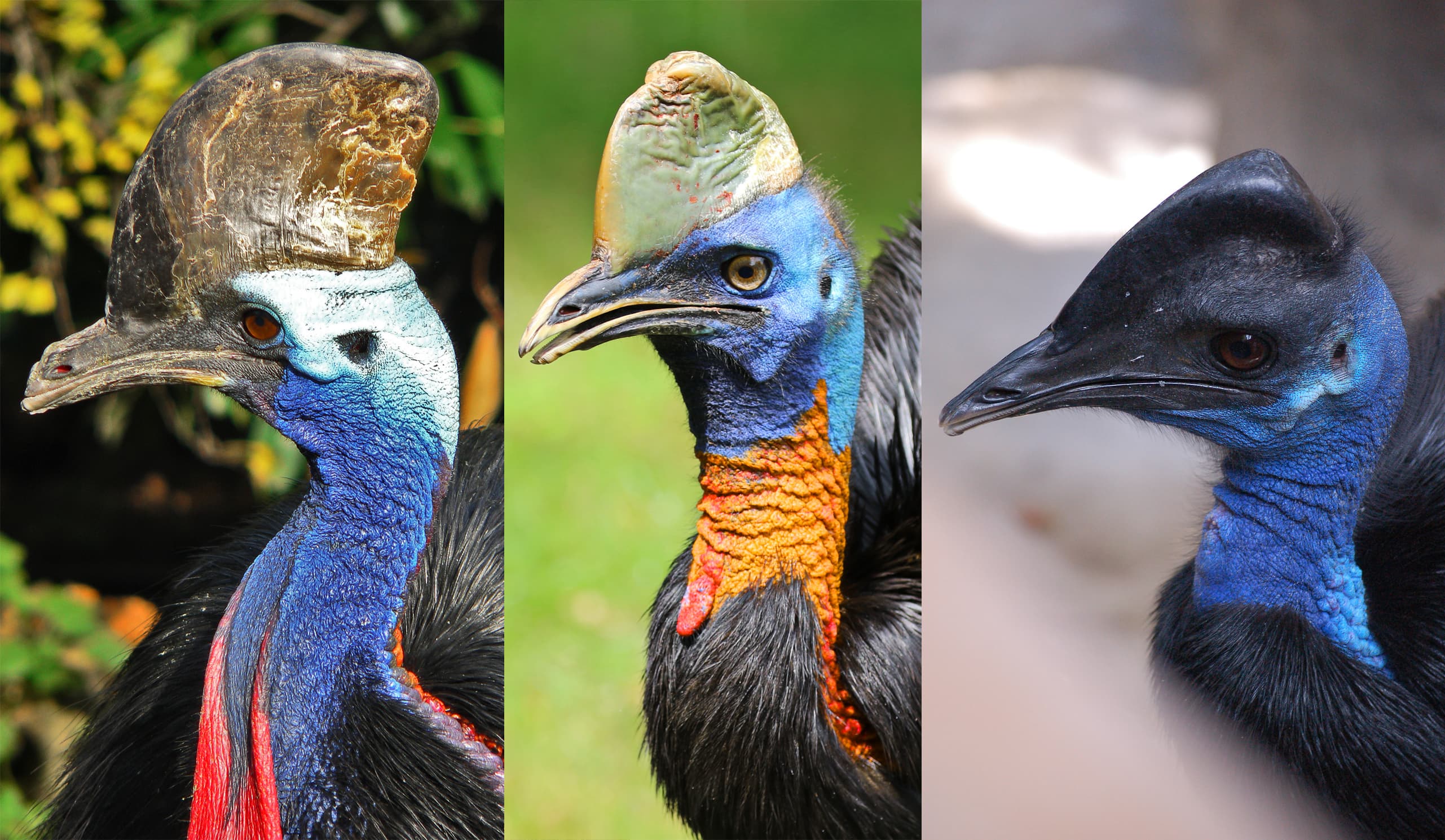
A huge, flightless bird with a blue neck and a helmet on its head

A southern cassowary with a bright blue neck and a tall horn on its head, standing in rainforest

Photo 路 Wikimedia Commons

What is it?

The cassowary is one of the biggest birds in the world - over 1.5 metres tall, almost as tall as a grown-up. It cannot fly, but it can run very fast through the rainforest. Its neck is bright blue, its eyes are red, and it has a tall hard helmet on top of its head called a 'casque'. Scientists call cassowaries the closest living birds to dinosaurs.

Tell me more

Cassowaries live in the thick rainforests of Papua New Guinea and northern Australia. They walk on big three-toed feet, and each foot has a long sharp middle claw. They mostly use those feet to scratch the ground for fallen fruit. Cassowaries love fruit - they eat hundreds of different kinds.

The tall helmet on top of a cassowary's head is hollow and made of the same stuff as your fingernails. Scientists think it helps the cassowary push through thick rainforest without scratching its head, and may also help it cool down. Each cassowary's casque has a slightly different shape, like a hat just for that bird.

Cassowaries are very important to the forest. They eat fruit, walk for kilometres, and then leave the seeds behind in their droppings - often far from the parent tree. Some big rainforest trees only sprout if their seeds have travelled through a cassowary first. Without cassowaries, parts of the forest would slowly disappear.

Cassowary dads do most of the parenting. The mother lays the eggs and then leaves. The father sits on the eggs for nearly two months without eating much, and then looks after the stripy brown chicks for almost a year. He teaches them which fruits are safe to eat and how to find them.

In the classroom

Walk your class through this in 15 minutes.

Talk together

Discussion prompts

  1. 01Why might a bird that cannot fly grow so tall and strong?
  2. 02Cassowary dads do all the parenting. What other animals can you think of where the dads look after the babies?
  3. 03If a forest needs cassowaries to spread its seeds, what would happen if the cassowaries vanished?
Try this

Classroom activity

Mark out 1.5 metres on the playground wall - that's the height of a cassowary. Stand next to it. Now find a partner and pace out the size of a cassowary's stride (about 1 metre at a walk, much more at a run). How fast can you walk one cassowary stride at a time?