
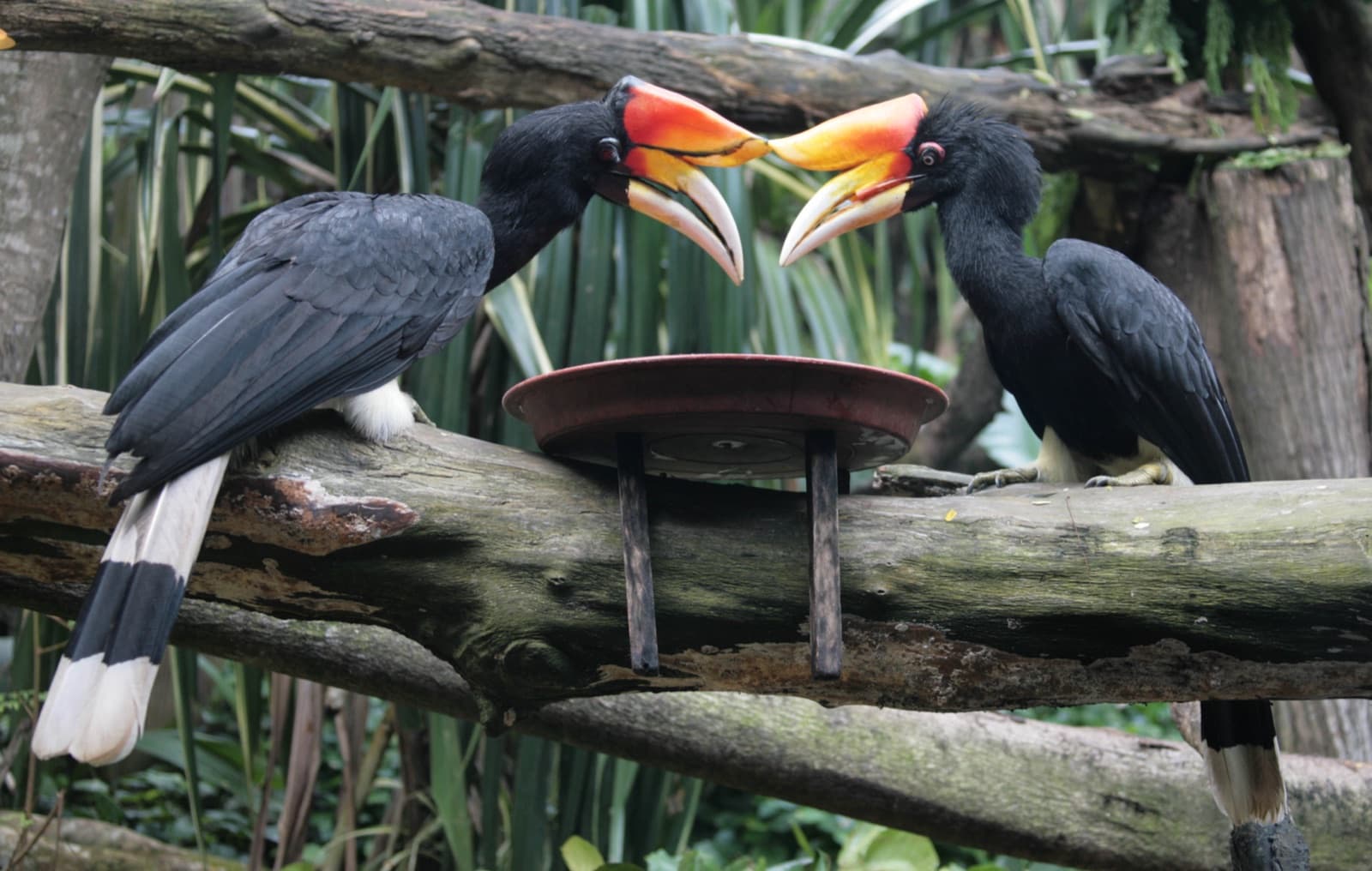
The rhinoceros hornbill has a bright orange-yellow casque that curves up like a horn. Despite looking heavy, the casque is mostly hollow - like a foam helmet - so the bird can still fly easily. Scientists think the casque helps make their calls louder, like a giant beak-shaped megaphone.
Hornbills are noisy. Their calls boom and honk through the forest, and you can often hear them coming from very far away. Their wings make a whooshing sound when they fly - some people describe it like a steam train chugging through the treetops. You usually hear a hornbill before you see one.
Hornbills make one of nature's strangest nests. The female squeezes into a hollow in a tree trunk to lay her eggs - and then she and the male seal the entrance shut with mud, leaving only a tiny letterbox-sized slot. The dad spends weeks bringing fruit through the slot to feed her and the babies. When the chicks are big enough, the family breaks out together.
Hornbills are very important to the rainforest. They love fruit, and after they eat, they fly long distances and drop the seeds in their poo. Those seeds grow into new trees. Without hornbills, many huge rainforest trees would have no way to spread. They are nature's gardeners.