
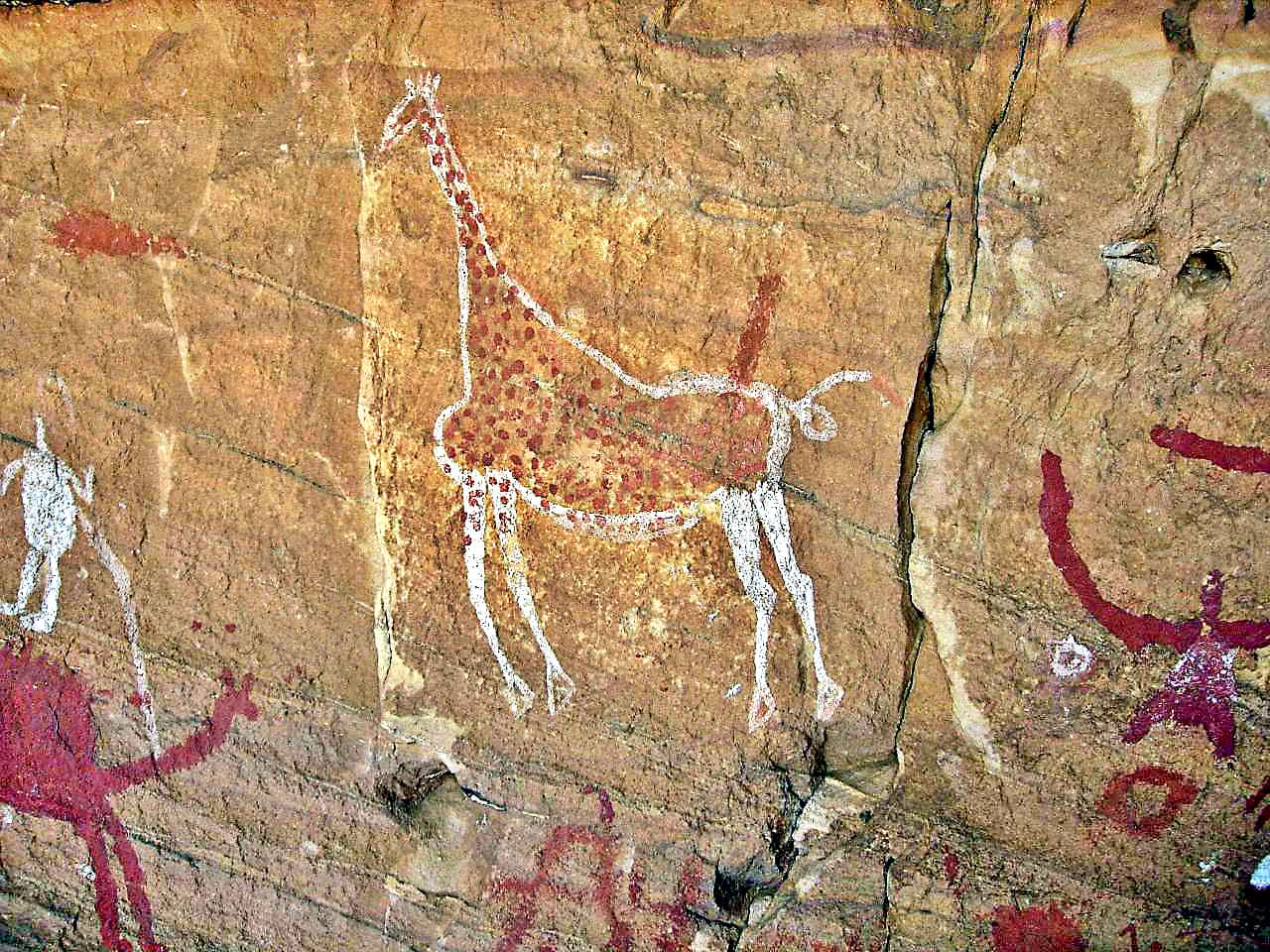
The paintings and carvings at Tadrart Acacus show animals that no longer live in Libya today - giraffes, elephants, crocodiles, and hippos. This tells us something amazing: thousands of years ago, this part of the Sahara was not a dry desert but a green, watered landscape with rivers and lakes. The Sahara was alive with wildlife.
The artists used natural pigments - red and yellow from iron-rich rocks, white from chalk, and black from charcoal - to paint on the stone surfaces. Some images are just outlines, others are filled in with colour and show movement, like a running animal or a dancing person. The quality of the work is extraordinary for any era.
There are thousands of individual images across the mountains - animals, people, handprints, and patterns. Some were made by different groups of people across different centuries, so looking at them is a bit like reading a very long picture book that was written by many different authors over thousands of years.
Researchers study the rock art to understand how the Sahara's climate changed over time, and what the daily life of these ancient people was like. The pictures are a record of a world that has completely disappeared - preserved in stone for us to discover today.