
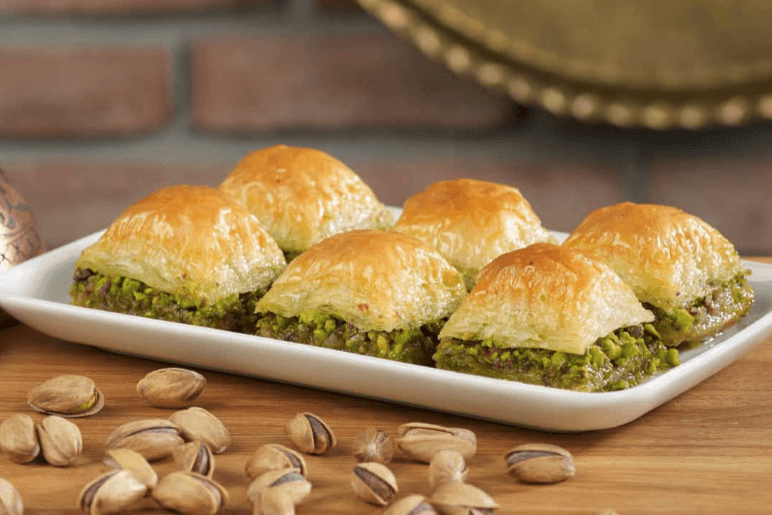
The dough is made into very thin sheets - about ten to fifteen layers stacked one on top of another, with sweetened ground nuts between each layer. When the cook is finally ready, the whole tray is cut into a beautiful diamond pattern. Once it has baked golden, hot syrup is poured over the top so it can soak deep into every layer.
Azerbaijani pakhlava is decorated with care. Each diamond has a half-walnut placed on top, and the surface is sometimes brushed with bright orange-yellow saffron water so the pastry shines. The trays are arranged like jewellery boxes.
Many parts of the Middle East and Mediterranean have their own baklava. The Azerbaijani version is special because it is shaped into diamonds, has a fresh, fragrant filling of walnuts or hazelnuts, and turns up most importantly on the Novruz holiday tray.
On Novruz, families lay out a special tray called the 'khoncha' - covered with sweets, fruits, sprouted wheat and dyed eggs. Pakhlava sits proudly in the middle. Children offer pieces to visitors, and visitors compliment the cook. By the end of Novruz week, the tray has been refilled many times.