
Classroom lesson 路 The Giant's Causeway馃嚠馃嚜 Ireland

The Giant's Causeway

40,000 hexagonal stone columns that look made by hand

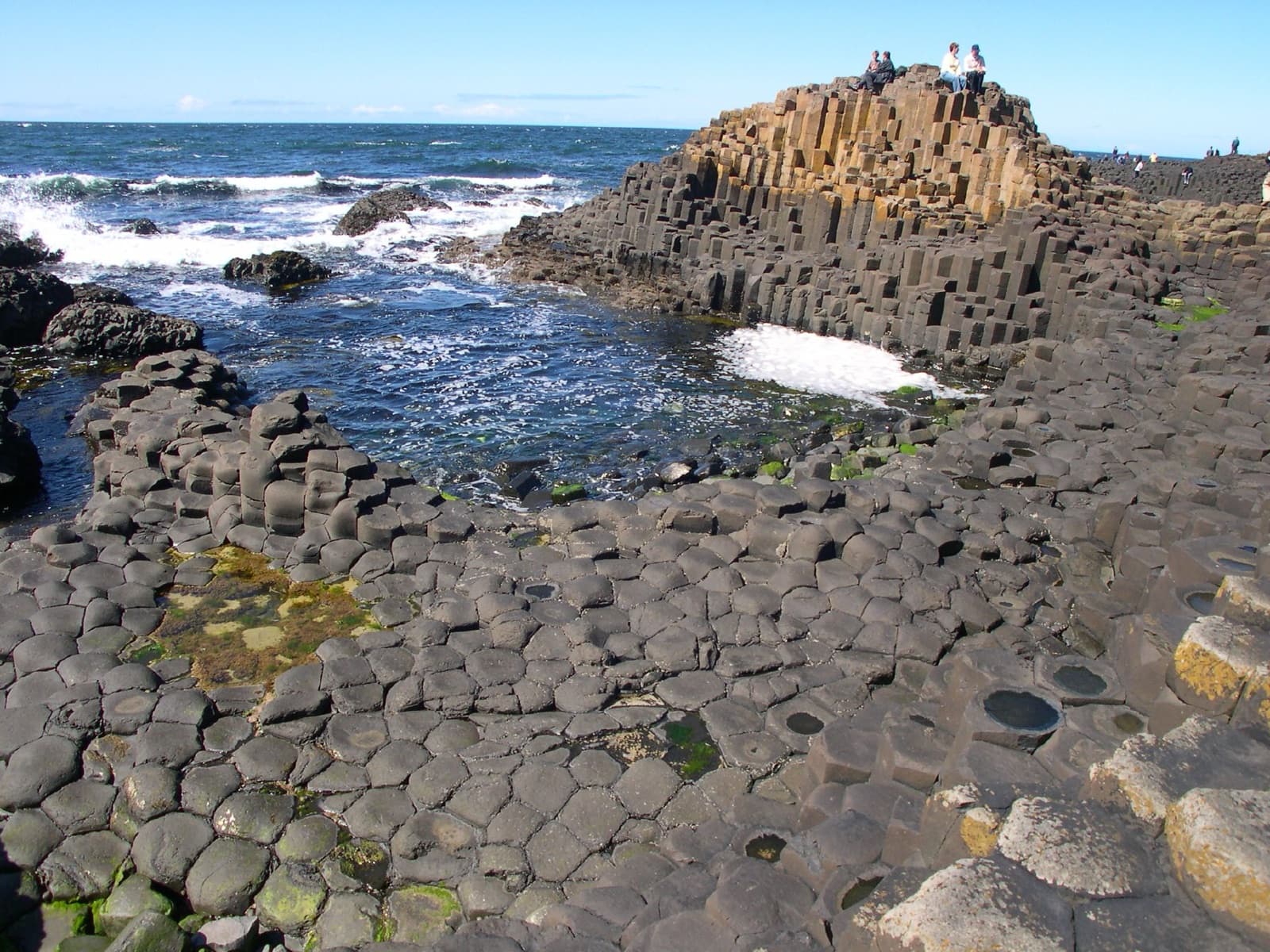
The hexagonal basalt columns of the Giant's Causeway at the edge of the sea

Photo 路 Wikimedia Commons

What is it?

The Giant's Causeway is an amazing place on the northern coast of the island of Ireland where around 40,000 stone columns rise out of the ground at the edge of the sea. Most of the columns have six sides - they look like a giant tiled floor.

Tell me more

The columns are made of a hard rock called basalt. They formed about 60 million years ago, when red-hot melted rock from inside the Earth came up through cracks in the ground. As the rock cooled down slowly, it shrank and split into these neat shapes - a bit like the way mud cracks into shapes when a puddle dries.

Most of the columns are hexagons (six-sided). But there are also pentagons (five), squares, sevens and eights. There are around 40,000 of them altogether, stretching down into the sea.

There is a wonderful old folk tale about how the Causeway was made. The story says a giant called Fionn mac Cumhaill (FINN mac-COOL) built it as a stepping-stone path across the sea so that he could go and fight another giant. Of course the real reason is the cooling lava - but the story is much more fun.

The Giant's Causeway is a UNESCO World Heritage Site, which means it is protected as important for the whole world. Around a million people visit every year. The columns are smooth and slippy where the sea has worn them down, so most visitors hop carefully from stone to stone.

In the classroom

Walk your class through this in 15 minutes.

Talk together

Discussion prompts

  1. 01How can natural rock look so neat that people thought a giant had built it?
  2. 02Why do you think stories often grow up around mysterious places?
  3. 03Hexagons appear all over nature - in honeycombs, snowflakes, and basalt. Why do you think nature likes that shape?
Try this

Classroom activity

Cut out paper hexagons and tessellate them together (fit them with no gaps). Try squares too, then circles. Which shapes leave no gaps? Which leave lots? Discuss why nature might choose the shapes that fit.