
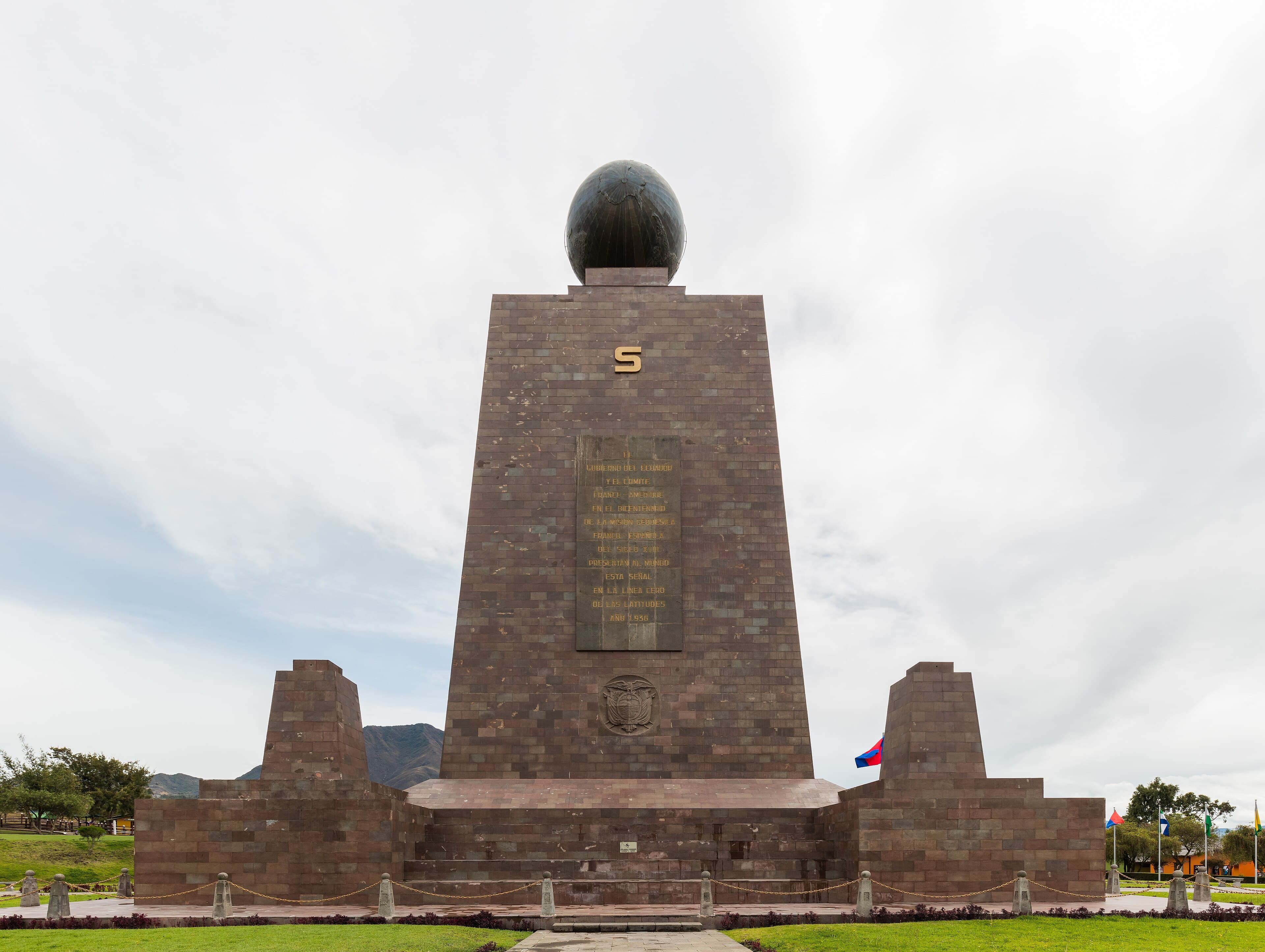
The Equator is an imaginary line drawn around the widest part of the Earth, exactly halfway between the North Pole and the South Pole. Ecuador is the only country in the world named after this line - in Spanish, 'Ecuador' actually means 'equator'.
The main monument at Mitad del Mundo is a big square tower about 30 metres tall with a large golden globe on top. A yellow stripe painted on the ground shows exactly where the Equator crosses. Tourists love to stand straddling the line - one foot in the northern half of the world, one foot in the southern half.
Near the Equator, the sun passes almost directly overhead at midday every single day of the year. This means that on the Equator, a stick pushed straight into the ground casts almost no shadow at noon. Scientists call this the 'zero shadow day' effect, and it happens twice a year when the sun is perfectly overhead.
Ecuador has several Indigenous communities that have lived along the Equator for thousands of years. Local guides share fascinating experiments at the site - balancing an egg on a nail, or watching water drain in different directions on each side of the line. Whether or not all the experiments work exactly as promised, they make for a brilliant lesson in geography!