
Classroom lesson · Wildlife · 🇧🇷 Brazil

The giant anteater

A 2-metre-long tongue, no teeth, and 30,000 ants for lunch

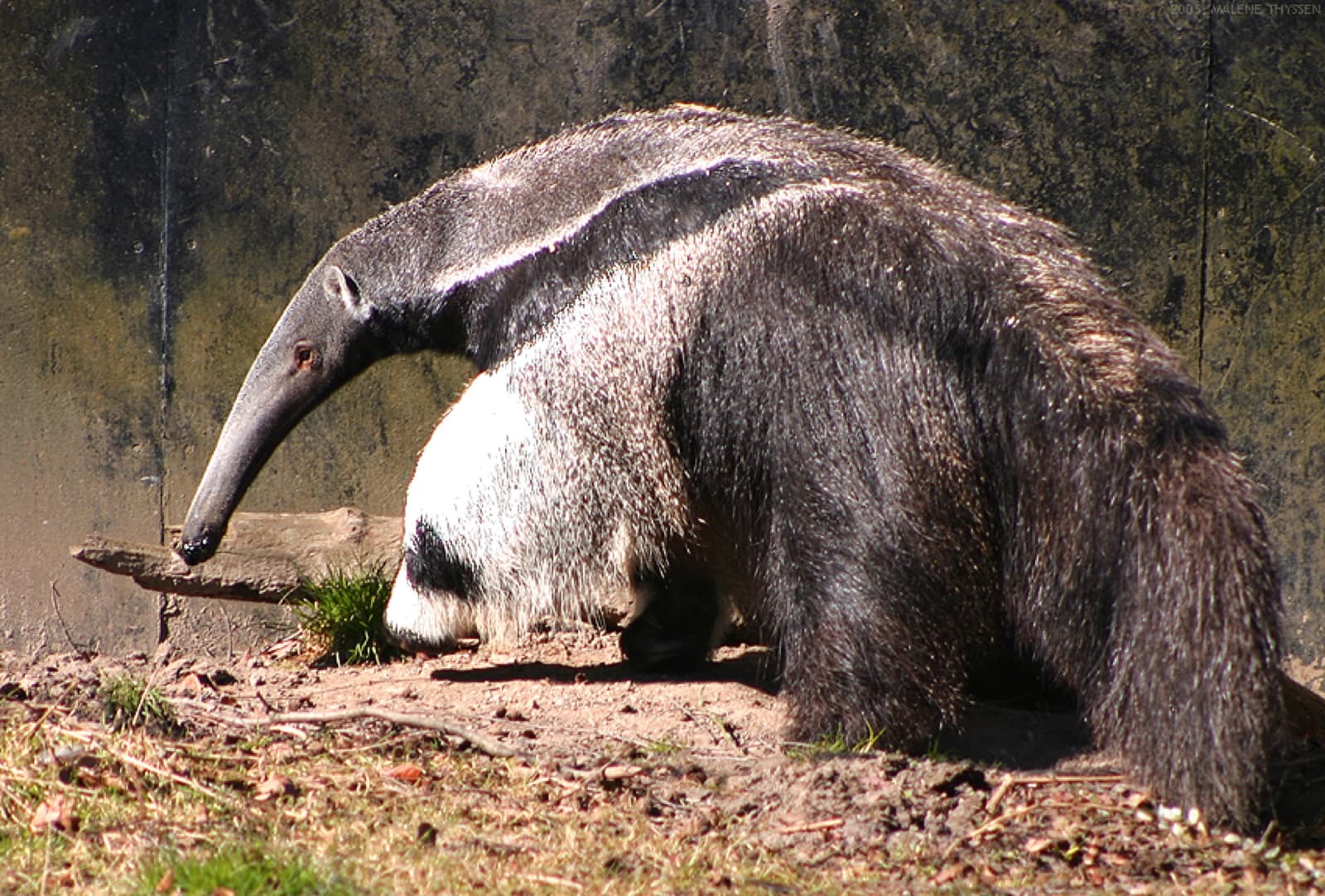
A giant anteater foraging on the ground, showing its long snout and bushy tail

Photo · Wikimedia Commons

What is it?

Giant anteaters are one of the most unusual animals in Brazil. They are about the size of a large dog, walk on their knuckles, have no teeth at all, and have a tongue over 50 cm long - longer than your arm. They live in the Pantanal and the grasslands of central Brazil.

Tell me more

An anteater's snout is long and tube-shaped, perfect for sticking into ant nests. Their tongue is round, sticky, and so long that they can flick it in and out around 150 times every minute. They use it to lick up ants and termites - up to 30,000 of them in a single day.

Because they don't have any teeth, they don't chew. They swallow the ants whole and let their tough stomach do the work. To help break the food down, they swallow tiny stones and bits of sand which grind everything up inside.

Giant anteaters have huge, bushy tails - so long that when they sleep, they curl up on the ground and use the tail like a blanket. From a distance, a sleeping anteater can look like a small bush or a pile of dry grass. It's brilliant camouflage.

Mother anteaters carry their babies on their back. The baby grips on tight, sometimes for up to a year, while mum walks around looking for ant nests. The baby's stripes line up perfectly with the mother's so it looks like one big anteater instead of two.

In the classroom

Walk your class through this in 15 minutes.

Talk together

Discussion prompts

  1. 01If you had to eat 30,000 of something tiny in a day, how would you do it? Could you stay still long enough?
  2. 02Anteaters have no teeth. What kinds of food can you eat without chewing? What couldn't you?
  3. 03A baby anteater's stripes match its mother's. Can you think of other animals that use camouflage to stay safe?
Try this

Classroom activity

Make a 'tongue ruler'. On a strip of paper, mark out 50 cm - the length of an anteater's tongue. Compare it to your arm, your foot, your height. Then try to imagine licking up 30,000 of anything in a day - work out how many that is per minute.