
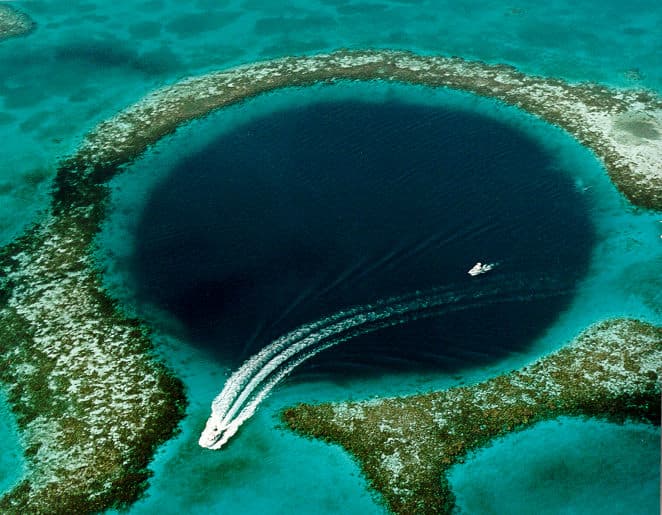
Thousands of years ago, the Great Blue Hole was a cave on dry land. Over a very long time, the sea level rose and covered the land, and the roof of the cave collapsed inward, leaving a huge circular hole in the seafloor. Divers who go down inside find enormous stalactites hanging from the walls - those are the pointy rock shapes that grow inside caves.
The water inside the hole is so deep that very little sunlight reaches the bottom, which is why it looks almost black-blue from above. Around the rim of the hole, bright coral grows and colourful fish dart about in the shallower water. Nurse sharks and several species of reef fish like to rest inside the hole.
The Great Blue Hole is part of the Belize Barrier Reef Reserve System, which is a UNESCO World Heritage Site. That means it is officially recognised as one of the most special and important natural places on Earth. Scientists and adventurers from all over the world come to Belize just to see it.
Even if you cannot dive, you can take a small plane or a helicopter and look down at the circle from the sky. Many people say that seeing it from the air is one of the most breathtaking things they have ever done.